Learn what every symbol on the card means.Full credits and sources at beakbrain.com/symbols
 ForestCup nestTiny · 10 g


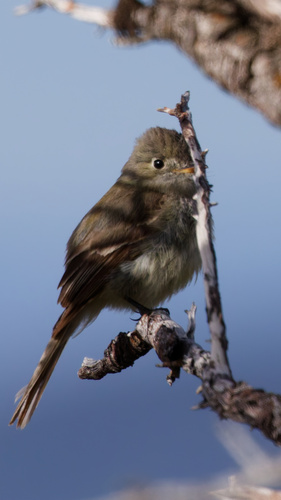
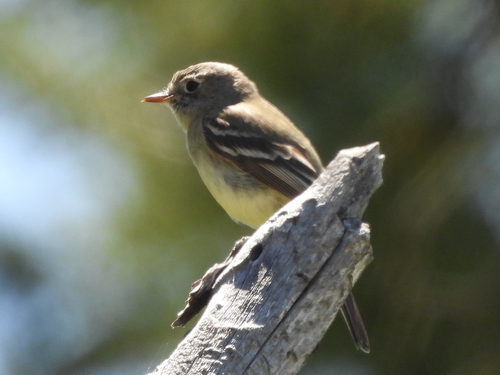
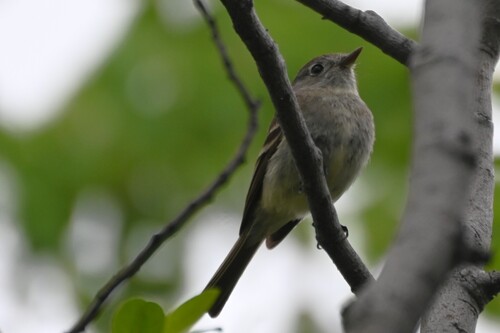
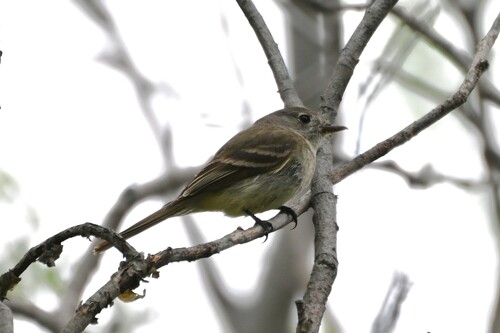

What the American Dusky Flycatcher sounds like

ID tip
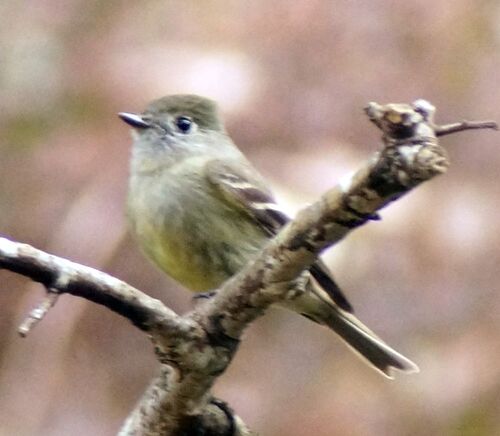
Adults have olive-gray upperparts, darker on the wings and tail, with whitish underparts; they have a noticeable medium-width white eye ring, white wing bars and a medium length tail. The breast is washed with olive-gray. The bill is mainly dark. It is a bit smaller than the American grey flycatcher and a bit larger than the Hammond's flycatcher. Voice: The male sings a three-part song. A common call is a dry whit, similar to that of other Empidonax flycatchers. A less common call, that is possibly only given by the male, is a sad dew-hic.
Text from Wikipedia, licensed CC BY-SA 4.0.
When to see the American Dusky Flycatcher
One bar for each month. Filled bars are the 6 months with records; pale bars are months with none. The wide bar is May, the month with the most records.
Where to see the American Dusky Flycatcher
The map shades 3 countries with regular records. Everything unshaded has no records. Countries are listed below the map.
About the American Dusky Flycatcher
The American dusky flycatcher, or simply dusky flycatcher, is a small insectivorous passerine of the tyrant flycatcher family.
Text adapted from Wikipedia, licensed CC BY-SA 4.0.
Easily confused with
 Hammond's FlycatcherEmpidonax hammondiiAdults are 12–14 cm long (4.7–5.5 in), span about 22 cm (8.7 in) across the wing and weigh 8–12 g (0.3–04 oz).
 Yellow-bellied FlycatcherEmpidonax flaviventrisAdults have greenish upperparts and yellowish underparts (especially on the throat), with a dusky wash on the chest.
 American Grey FlycatcherEmpidonax wrightiiAmerican gray flycatchers are small birds, but larger than most Empidonax flycatchers.
Side by side: American Dusky Flycatcher vs Yellow-bellied Flycatcher · American Dusky Flycatcher vs Hammond's Flycatcher · American Dusky Flycatcher vs Piratic Flycatcher · American Dusky Flycatcher vs American Grey Flycatcher
Learn the American Dusky Flycatcher in the BeakBrain App
Photo and call practice. Coming soon to iPhone and Android.
Play today's Daily BirdEvery photo and recording on this page is credited to its author under the licence shown. Spotted a problem with this page, or have a better photo? Contribute.