Learn what every symbol on the card means.Full credits and sources at beakbrain.com/symbols
 ForestPlatform nestLarge · 380 g


What the Amazonian Umbrellabird sounds like

ID tip
Much larger than the female, the male Amazonian umbrellabird is likely the largest passerine in South America as well as the largest suboscine passerine in the world. The male Amazonian umbrellabird grows to a weight of 480–571 grams (1.06–1.26 lb) and a length of 48–55 centimetres (18.9–21.7 in). The female typically stands 41–44 centimetres (16.1–17.3 in) tall and weighs up to 380 grams (0.84 lb).
Text from Wikipedia, licensed CC BY-SA 4.0.
When to see the Amazonian Umbrellabird
One bar for each month, and every month is filled: this bird is recorded here in all twelve. The wide bar is January, the month with the most records.
Where to see the Amazonian Umbrellabird
The map shades 7 countries with regular records. Everything unshaded has no records. Countries are listed below the map.
About the Amazonian Umbrellabird
The Amazonian umbrellabird is a species of bird in the family Cotingidae native to the Amazon basin with a separate population on the eastern slopes of the Andes. The male bird is entirely black, with a black crest and inflatable wattle on the throat, and at 48 to 55 cm, may be the largest passerine bird in South America. The female is slightly smaller. Both have an undulating flight, described as woodpecker-like, and the male has a loud, booming call.
Text adapted from Wikipedia, licensed CC BY-SA 4.0.
Easily confused with
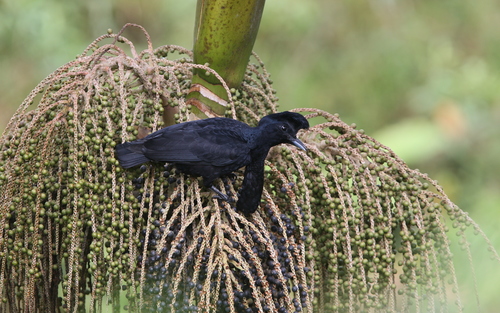 Long-wattled UmbrellabirdCephalopterus penduligerThe male is 40–42 cm in height, with the female being slightly smaller at 35–37 cm.
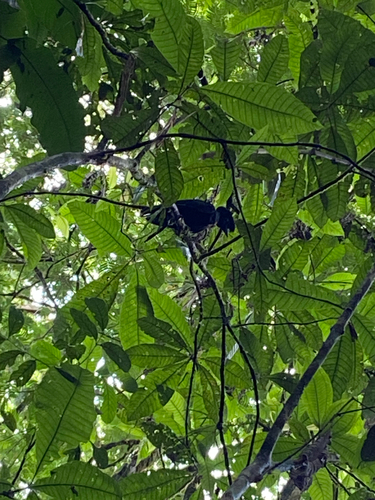 Bare-necked UmbrellabirdCephalopterus glabricollisThe bare-necked umbrellabird is a large, bulky, and crow-like bird, being the largest passerine in its range.
Side by side: Amazonian Umbrellabird vs Long-wattled Umbrellabird
Learn the Amazonian Umbrellabird in the BeakBrain App
Photo and call practice. Coming soon to iPhone and Android.
Play today's Daily BirdEvery photo and recording on this page is credited to its author under the licence shown. Spotted a problem with this page, or have a better photo? Contribute.