Learn what every symbol on the card means.Full credits and sources at beakbrain.com/symbols
 ForestPlatform nestLarge · 567 g



ID tip
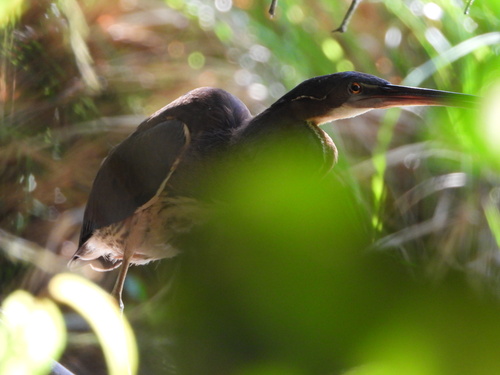
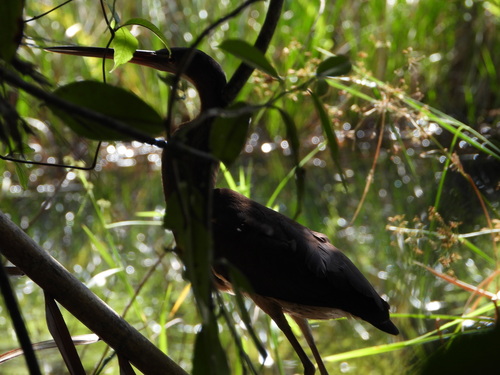
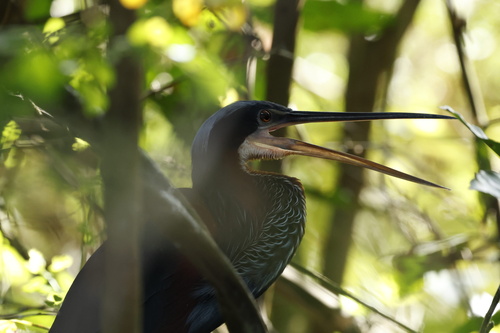
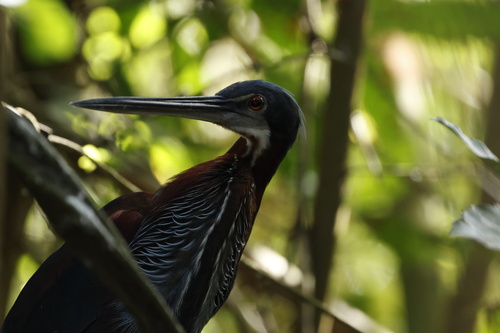
This uncommon species is 66–76 centimetres (26–30 inches) in length. It is short-legged for a heron, and has a thin bill which is considerably longer than the head. The neck and underparts are chestnut, with a white line down the centre of the foreneck, and the wings are shiny green. Wispy pale blue feathers decorate the crown, sides of the foreneck, and lower back. The legs, bill, and bare facial patch are dull yellow. During the breeding season the facial patch can change color to reddish.
Text from Wikipedia, licensed CC BY-SA 4.0.
When to see the Agami Heron
One bar for each month, and every month is filled: this bird is recorded here in all twelve. The wide bar is February, the month with the most records.
Where to see the Agami Heron
The map shades 16 countries with regular records. Everything unshaded has no records. Countries are listed below the map.
About the Agami Heron
The agami heron is a medium-sized heron. It is a resident breeding bird from Central America south to Peru and Brazil. It is sometimes known as the chestnut-bellied heron, and is the only member of the genus Agamia. In Brazil it is sometimes called Soco beija-flor, meaning 'hummingbird heron', thanks to its unique coloration pattern.
Text adapted from Wikipedia, licensed CC BY-SA 4.0.
Easily confused with
 Pinnated BitternBotaurus pinnatusThe pinnated bittern is a large heron, measuring between 25–30 in (64–76 cm) with a weight that ranges from 554 to 1,157 g (1.2 to 2.6 lb); males typically weigh considerably more than females.
 Australasian BitternBotaurus poiciloptilusThe Australasian bittern, or Matuku-hūrepo in Māori, is a stocky, sizeable and elusive heron-like bird native to the wetlands of Australia, New Zealand, and New Caledonia.
 Great-billed HeronArdea sumatranaThe great-billed heron is a large bird, typically standing 115 cm (45 in) tall and weighing up to 2.6 kg (5.7 lb).
Side by side: Agami Heron vs Pinnated Bittern · Agami Heron vs Great-billed Heron
Learn the Agami Heron in the BeakBrain App
Photo and call practice. Coming soon to iPhone and Android.
Play today's Daily BirdEvery photo and recording on this page is credited to its author under the licence shown. Spotted a problem with this page, or have a better photo? Contribute.