Learn what every symbol on the card means.Full credits and sources at beakbrain.com/symbols
 WoodlandCup nestMedium · 65 g


ID tip
The African Thrush has dark olive-grey upperparts. The underparts show a whitish evenly brown- streaked side throat, the breast is greyish brown and the flanks are pale buff-orange with this colour not extending on to the lower breast, the belly and vent are white. It has a yellow-orange bill. It weighs 46–78 g (1.6–2.8 oz) and measures 21–23 cm (8.3–9.1 in) in length. Voice: The song of the African thrush is a sustained, clear warbling made up of different phrases repeated rather randomly in a sequence. Also a high-pitched squealing flight call.
Text from Wikipedia, licensed CC BY-SA 4.0.
When to see the African Thrush
One bar for each month, and every month is filled: this bird is recorded here in all twelve. The wide bar is July, the month with the most records.
Where to see the African Thrush
The map shades 31 countries with regular records, and 1 more in a lighter tone where the bird turns up only as a stray. Everything unshaded has no records. Countries are listed below the map.
Recorded as a rare visitor in Sudan.
About the African Thrush
The African thrush or West African thrush is a passerine bird in the thrush family Turdidae. It is common in well-wooded areas over much of the western part of sub-Saharan Africa, it was once considered to be conspecific with the olive thrush but that species has now been split further. Populations are resident (non-migratory).
Text adapted from Wikipedia, licensed CC BY-SA 4.0.
Easily confused with
 Yellow-legged ThrushTurdus flavipesThe yellow-legged thrush is 20 to 22 cm (7.9 to 8.7 in) long and weighs 55 to 72 g (1.9 to 2.5 oz).
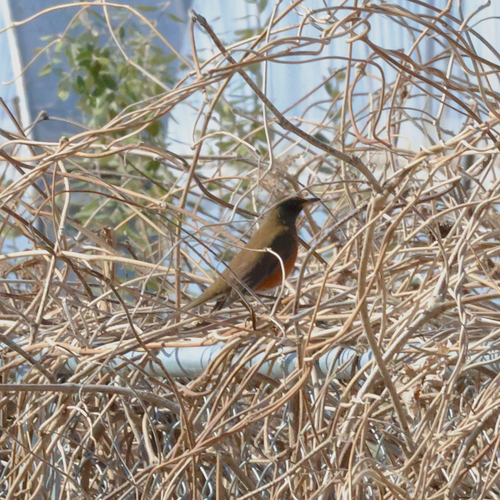 Brown-headed ThrushTurdus chrysolausThe brown-headed thrush, sometimes known as the brown thrush, is a species of bird in the family Turdidae.
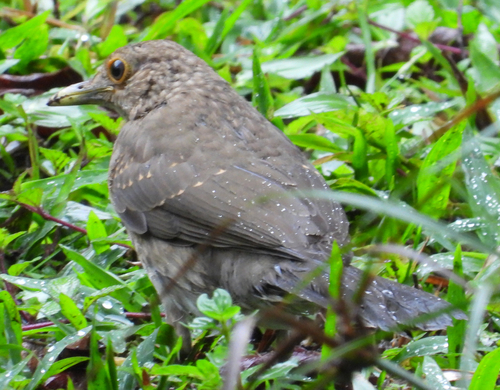 Ecuadorian ThrushTurdus maculirostrisThe Ecuadorian thrush is 21.5 to 23 cm (8.5 to 9.1 in) long and weighs 62 to 76 g (2.2 to 2.7 oz).
Side by side: African Thrush vs Yellow-legged Thrush · African Thrush vs Ecuadorian Thrush · African Thrush vs Glossy-black Thrush
Learn the African Thrush in the BeakBrain App
Photo and call practice. Coming soon to iPhone and Android.
Play today's Daily BirdEvery photo and recording on this page is credited to its author under the licence shown. Spotted a problem with this page, or have a better photo? Contribute.