Learn what every symbol on the card means.Full credits and sources at beakbrain.com/symbols
 ForestDomed nestMedium · 63 g

ID tip
The sexes are alike. The crown, face, and ear coverts are solid black, and the throat is pale salmon pink. The broad eyebrow is buff to brownish buff. The flanks, breast, and side of the neck are a mustard yellow, washed olive on the upper breast. Some western birds have the breast very greenish. The wing coverts are deep green and tipped turquoise blue, or black and tipped turquoise and royal blue. The mantle and back are green, and the rump and upper tail coverts pale turquoise blue. The wings are rounded, and the primaries are black with pale and white tips.
Text from Wikipedia, licensed CC BY-SA 4.0.
When to see the African Pitta
One bar for each month. Filled bars are the 8 months with records; pale bars are months with none. The wide bar is December, the month with the most records.
Where to see the African Pitta
The map shades 15 countries with regular records. Everything unshaded has no records. Countries are listed below the map.
About the African Pitta
The African pitta is an Afrotropical bird of the family Pittidae. It is a locally common to uncommon species, resident and migratory in the west, and an intra-African migrant between equatorial and southeastern Africa. They are elusive and hard to observe despite their brightly coloured plumage, and their loud, explosive calls are infrequently heard. The plump, somewhat thrush-like birds forage on leaf litter under the canopy of riparian or coastal forest and thickets, or in climax miombo forest. They spend much time during mornings and at dusk scratching in leaf litter or around termitaria, or may stand motionless for long periods.
Text adapted from Wikipedia, licensed CC BY-SA 4.0.
Easily confused with
 Green-breasted PittaPitta reichenowiThe plumage is very similar to that of the African pitta, but the breast is green and the throat is bordered by a black line.
 Elegant PittaPitta elegansThe elegant pitta is 19 cm (7.5 in) long and weighs 47–77 g (1.7–2.7 oz).
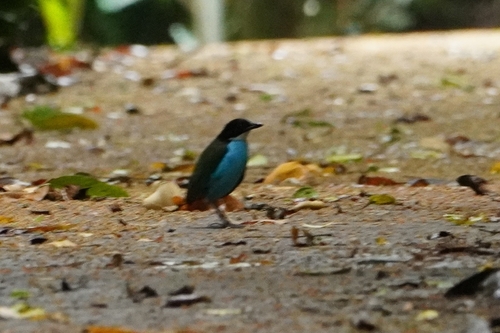 Azure-breasted PittaPitta steeriiThe azure-breasted pitta is a species of bird in the family Pittidae.
Learn the African Pitta in the BeakBrain App
Photo and call practice. Coming soon to iPhone and Android.
Play today's Daily BirdEvery photo and recording on this page is credited to its author under the licence shown. Spotted a problem with this page, or have a better photo? Contribute.