Learn what every symbol on the card means.Full credits and sources at beakbrain.com/symbols
 ForestCup nestSmall · 51 g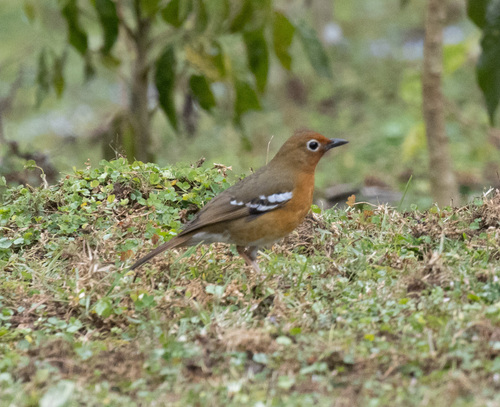
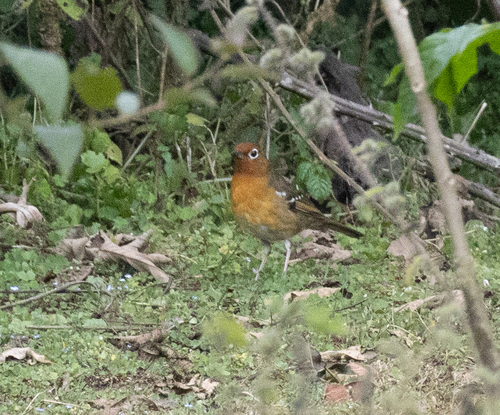


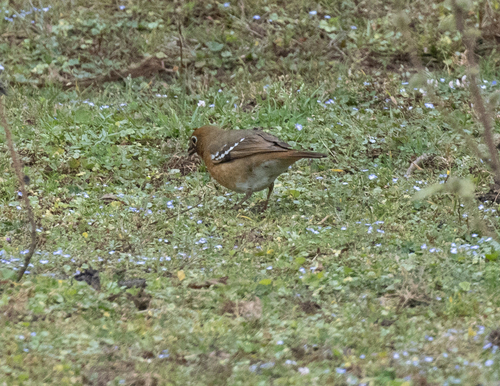
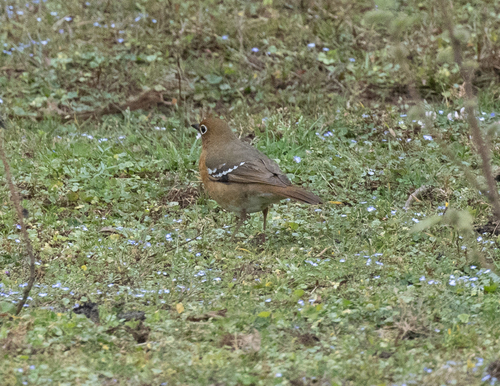
ID tip
The Abyssinian ground thrush is an attractive but rather secretive species. The adults are a deep rufous orange on the head and face with a distinct white eye ring, the orange colour becomes les rufous on the breast and flanks and the upperparts are olive brown except for the orange-brown rump and tail. On the folded wing it shows two prominent white wingbars from the tips to the coverts. Immature birds tend to be paler and duller than the adults. They measure 19–20 cm (7.5–7.9 in) in length and weigh 43–65 g (1.5–2.3 oz). Voice: The contact call of the Abyssinian ground thrush is a high pitched "tseep", the song is a typical thrush like melodious series of whistled phrases rendered in Sinclair & Ryan as "chee-cheeleeroo-chruup".
Text from Wikipedia, licensed CC BY-SA 4.0.
When to see the Abyssinian Ground Thrush
One bar for each month, and every month is filled: this bird is recorded here in all twelve. The wide bar is November, the month with the most records.
Where to see the Abyssinian Ground Thrush
The map shades 7 countries with regular records. Everything unshaded has no records. Countries are listed below the map.
About the Abyssinian Ground Thrush
The Abyssinian ground thrush is a thrush from the family Turdidae which is native to north-east Africa where it lives at high altitude in montane forests. Its binomial nomenclature honors the 19th century Italian explorer of East Africa Carlo Piaggia.
Text adapted from Wikipedia, licensed CC BY-SA 4.0.
Easily confused with
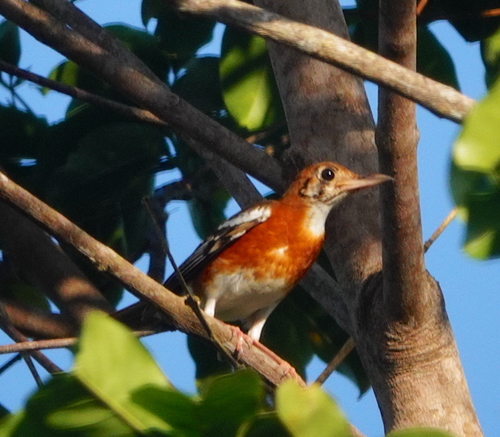 Orange-sided ThrushGeokichla peroniiThe orange-sided thrush or orange-banded thrush is a species of bird in the family Turdidae.
 Ashy ThrushGeokichla cinereaThe ashy thrush, also known as the ashy ground-thrush, is a species of bird in the family Turdidae.
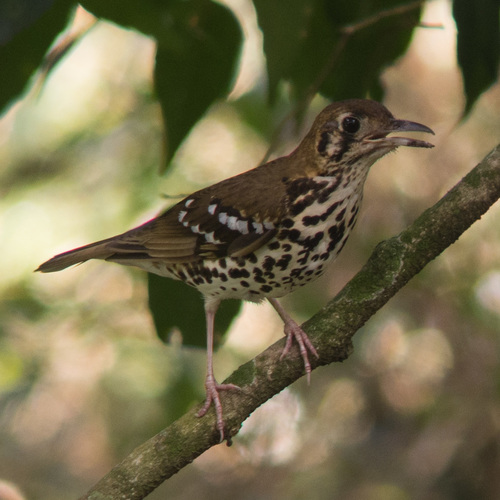 Spotted Ground ThrushGeokichla guttataThese birds are about 23 cm in length, with brown upper parts and white to off-white lower parts which are darkly spotted.
Learn the Abyssinian Ground Thrush in the BeakBrain App
Photo and call practice. Coming soon to iPhone and Android.
Play today's Daily BirdEvery photo and recording on this page is credited to its author under the licence shown. Spotted a problem with this page, or have a better photo? Contribute.