Learn what every symbol on the card means.Full credits and sources at beakbrain.com/symbols
 Woodland22 g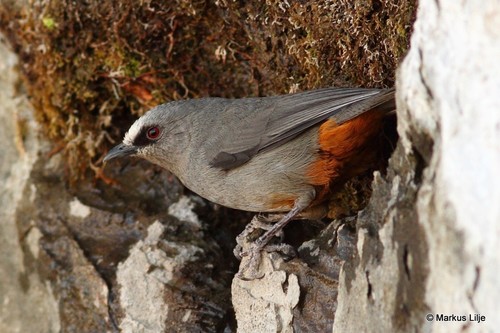


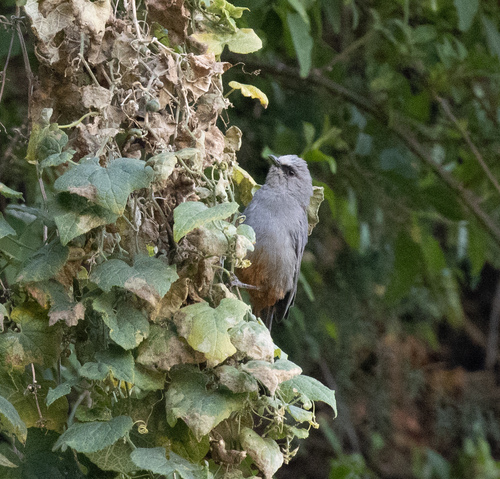
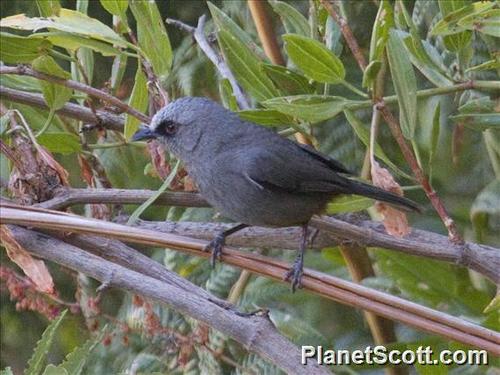
ID tip
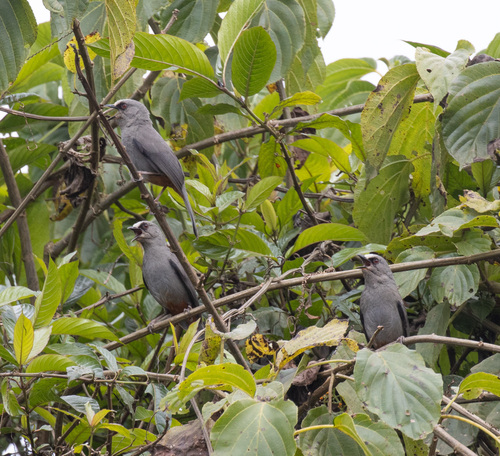
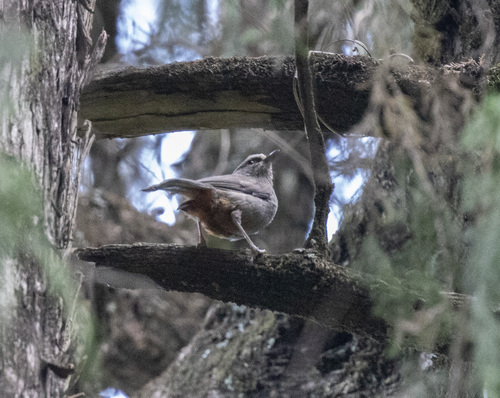
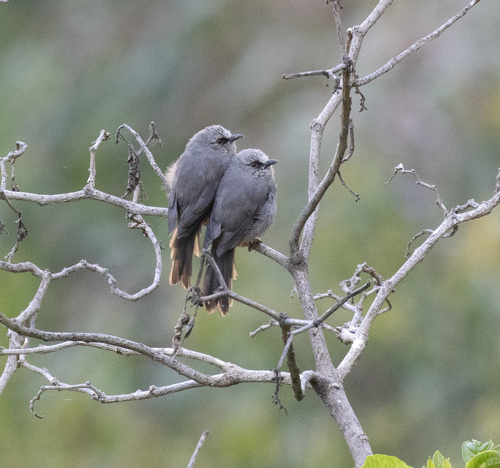
The Abyssinian catbird is a small-sized babbler. Its body is round with relatively short wings and legs. The bird's belly is white, but its upper parts are a lighter shade of grey that gradually fades to a darker shade moving to the backside of the bird. The head of the bird is a light shade of grey with dark highlights surrounding the eyes. The eyes themselves have a scarlet iris surrounding dark brown pupils. The beak is short pointed and black. Its wings are the darkest parts of its body having parallel bars of black along its length with the rest of the wing being grey.
Text from Wikipedia, licensed CC BY-SA 4.0.
When to see the Abyssinian Catbird
One bar for each month. Filled bars are the 9 months with records; pale bars are months with none. The wide bar is December, the month with the most records.
Where to see the Abyssinian Catbird
The map shades 1 country with regular records, and 1 more in a lighter tone where the bird turns up only as a stray. Everything unshaded has no records. Countries are listed below the map.
Recorded as a rare visitor in Kenya.
About the Abyssinian Catbird
The Abyssinian catbird, also known as the juniper babbler, is a small passerine in the family Sylviidae, endemic to the highland forests and scrub of Ethiopia. Despite its name, it is unrelated to other birds called "catbirds." It is mostly grey, with black lores, a whitish forehead, and a chestnut vent.
Text adapted from Wikipedia, licensed CC BY-SA 4.0.
Easily confused with
 Dohrn's WarblerSylvia dohrniDohrn's warbler, also known as Principe flycatcher-babbler, Dohrn's flycatcher, Dohrn's thrush-babbler, is a species of passerine bird in the family Sylviidae that is endemic to the island of Príncipe which lies off the west coast of Africa in the Gulf of Guinea.
 Rwenzori Hill BabblerSylvia atricepsThe Rwenzori hill babbler is a species of passerine bird in the family Sylviidae that is found in Africa.
 African Hill BabblerSylvia abyssinicaThe African hill babbler is an arboreal robin-like forest bird with a thin bill, bright reddish brown back and a contrasting grey head and nape.
Learn the Abyssinian Catbird in the BeakBrain App
Photo and call practice. Coming soon to iPhone and Android.
Play today's Daily BirdEvery photo and recording on this page is credited to its author under the licence shown. Spotted a problem with this page, or have a better photo? Contribute.