Learn what every symbol on the card means.Full credits and sources at beakbrain.com/symbols
 MarinePlatform nestHuge · 1.6 kg


ID tip
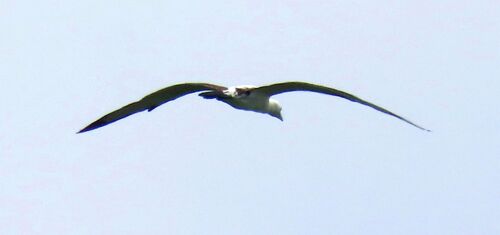
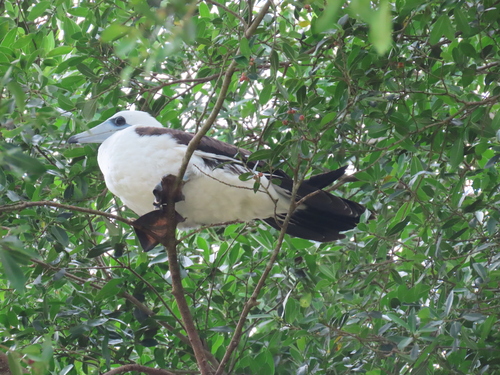
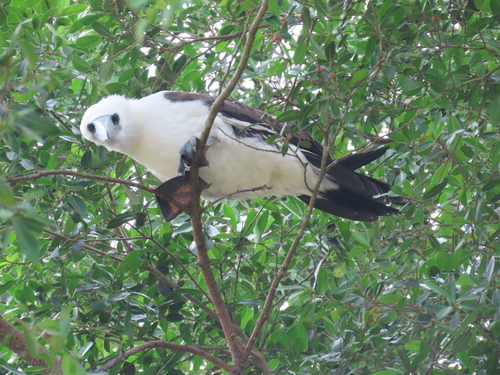
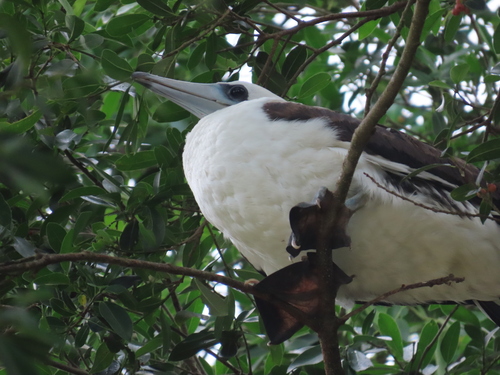
Abbott's booby is the largest of all booby species, and is adapted to long-distance flight. Individuals can reach 80 cm (31 in) from beak to tail, and weigh about 1.5 kg (3.3 lb). It is distinguished from other sulids in the region by its black and white plumage; the only other bird with similar coloration and shape is the masked booby, which has an all-white body with black wings only. They have an off-white plumage, which contrasts with black eye patches, black wings and tails, and black flank marks. Their feet are blue and webbed, with black outer ends.
Text from Wikipedia, licensed CC BY-SA 4.0.
When to see the Abbott's Booby
One bar for each month. Filled bars are the 9 months with records; pale bars are months with none. The wide bar is November, the month with the most records.
Where to see the Abbott's Booby
The map shades 2 countries with regular records, and 1 more in a lighter tone where the bird turns up only as a stray. Everything unshaded has no records. Countries are listed below the map.
Recorded as a rare visitor in Australia.
About the Abbott's Booby
Abbott's booby is an endangered seabird of the sulid family, which includes gannets and boobies. It is a large booby and is placed within its own monotypic genus. It was first identified from a specimen collected by William Louis Abbott, who discovered it on Assumption Island in 1892.
Text adapted from Wikipedia, licensed CC BY-SA 4.0.
Easily confused with
 Cocos BoobySula brewsteriThe most immediately obvious difference from the related brown booby is the male's whitish face, varying in size by subspecies.
 Nazca BoobySula grantiThe species has a yellow iris, orange and pinkish beak, black facial skin in the form of a mask, and grey feet.
 Masked BoobySula dactylatraThe largest species of booby, the masked booby ranges from 75 to 85 cm (30 to 33 in) long, with a 160–170 cm (63–67 in) wingspan and 1.2–2.2 kg (2.6–4.9 lb) weight.
Learn the Abbott's Booby in the BeakBrain App
Photo and call practice. Coming soon to iPhone and Android.
Play today's Daily BirdEvery photo and recording on this page is credited to its author under the licence shown. Spotted a problem with this page, or have a better photo? Contribute.