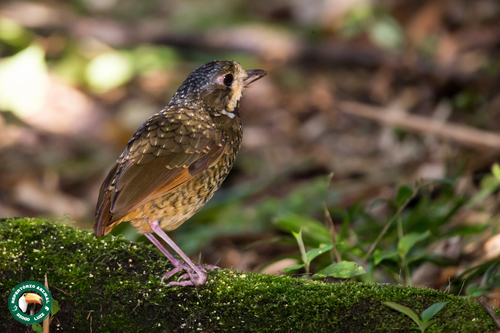
Variegated Antpitta
Grallaria varia
Grallaria antpittas are a "wonderful group of plump and round antbirds whose feathers are often fluffed up...they have stout bills very short tails". The variegated antpitta is the largest member of its genus that occurs in the lowlands; it is 16 to 20.5 cm (6.3 to 8.1 in) long and weighs 90 to 135 g (3.2 to 4.8 oz). The sexes have the same plumage. Adults of the nominate subspecies G. v. varia have a dark olive forecrown; they have a slate gray crown and nape whose feathers have black tips and pale shafts. Voice: The song of the G. v. imperator variegated antpitta consists of a series of 11–14 notes, beginning with four to six long notes, increasing in volume, then rising slightly in pitch and pace to a series of six to eight loud, shorter notes, with the last note weaker.
ID text from Wikipedia, CC BY-SA 4.0
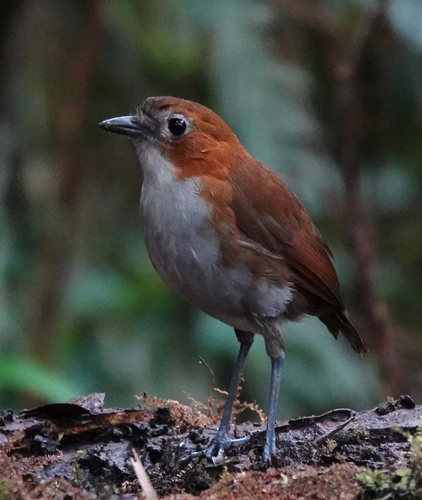
White-bellied Antpitta
Grallaria hypoleuca
Grallaria antpittas are a "wonderful group of plump and round antbirds whose feathers are often fluffed up...they have stout bills very short tails". The white-bellied antpitta is 16 to 18 cm (6.3 to 7.1 in) long; three males weighed 62 to 69 g (2.2 to 2.4 oz). The sexes have the same plumage. Adults of the nominate subspecies G. h. hypoleuca have a rufescent brown or dusky brown crown with some black streaks on the forecrown. They have white or gray lores on a rufous face. Their back, rump, wings, and tail are reddish brown. Their throat is white. Voice: The white-bellied antpitta's "simple and far-carrying song a fast too, téw-téw, given at rather long intervals (often 10 or more seconds)". Its call is "a strikingly pygmy-owl -like vocalization, too, too, too, too ...". The species typically sings from a perch within about 2 m (7 ft) of the ground.
ID text from Wikipedia, CC BY-SA 4.0

Learn this pair in the BeakBrain App
Photo and call practice. Coming soon to iPhone and Android.
Play today's Daily BirdPhotos and recordings are credited to their authors under the licence shown. Full profiles: Variegated Antpitta and White-bellied Antpitta.