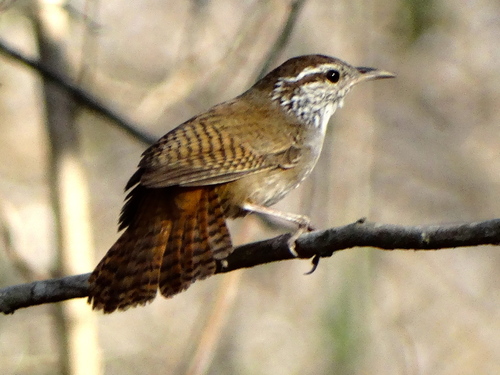
Sinaloa Wren
Thryophilus sinaloa
The Sinaloa wren is 11.8 to 14 cm (4.6 to 5.5 in) long and weighs 10.9 to 19.8 g (0.38 to 0.70 oz). The nominate adults have dull brown upperparts that become more rufescent on the rump. The tail is rufous brown with black or dusky bars. They have a white to buffy white supercilium, a black streak behind the eye, and dusky-striped white cheeks. The sides of the neck have broad black and white streaks. The throat and breast are white darkening to pale brown on the flanks. Juveniles are similar but their flanks are paler and more cinnamon and the facial markings less distinct. The adult T. s. Voice: The Sinaloa wren has a complex song. It has variously been described as "loud and variable...composed of rich phrases" and "clear gurgling whistles...with a rapid series of short trills" . Calls include "a rough buzzy rasp" and "a hard, dry chatter" .
ID text from Wikipedia, CC BY-SA 4.0
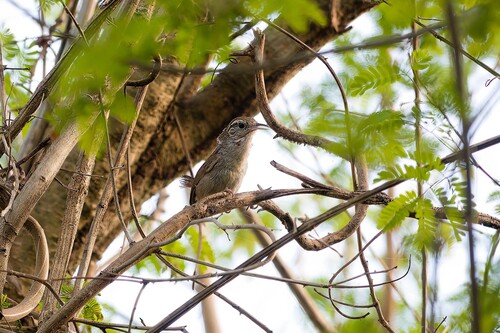
White-bellied Wren
Uropsila leucogastra
The white-bellied wren is 9.5 to 10 cm (3.7 to 3.9 in) long. Males weigh 9.8 to 10.5 g (0.35 to 0.37 oz) and females 8 to 9.1 g (0.28 to 0.32 oz). The nominate subspecies has a medium brown crown, upperparts, and tail; the rump is slightly reddish and the tail has many thin dark bars. It has a gray-white supercilium, a medium brown stripe behind the eye, and gray cheeks mottled with brown. Its throat, chest, and upper belly are gray and the flanks and vent area buff. The other subspecies differ somewhat in the intensity of the brown of the upperparts and the bars on the tail. Voice: The white-bellied wren's song is "a short series of 6 rapid up-and-down notes, descending at end", rather bubbly in the eastern population but not the western. Its calls include a "low 'chek', scolding chatter, and hard dry cracking rattle."
ID text from Wikipedia, CC BY-SA 4.0
Where you might meet both
Learn this pair in the BeakBrain App
Photo and call practice. Coming soon to iPhone and Android.
Play today's Daily BirdPhotos and recordings are credited to their authors under the licence shown. Full profiles: Sinaloa Wren and White-bellied Wren.