
Scott's Oriole
Icterus parisorum
Scott's oriole is about 23 cm (9.1 in) long with a wingspan of 32 cm (13 in); it weighs 32 to 41 g (1.1 to 1.4 oz). Adult males in breeding plumage have a black head, back, scapulars, throat, and breast. Their rump, uppertail coverts, and underparts below the breast are lemon yellow. Their wings are black with pale yellow lesser and median coverts that show as an epaulet. The wing's greater coverts have white tips that show as a wing bar. Their tail feathers are mostly black with yellow bases and white tips, both of which are larger towards the outer feathers. Voice: The song of Scott's oriole is a "series of varied, short notes...; pure whistles (notes with a single dominant frequency) interspersed with notes that are rapidly modulated in frequency, some ascending, some descending, and some with both ascending and descending portions". Both sexes sing but female song is usually not as complex as male song.
ID text from Wikipedia, CC BY-SA 4.0

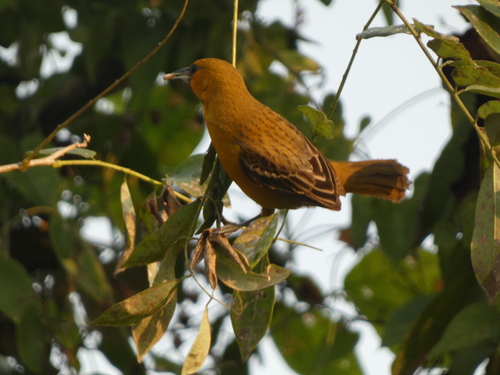
Streak-backed Oriole
Icterus pustulatus
The streak-backed oriole is 19 to 21 cm (7.5 to 8.3 in) long. Males weigh an average of about 43 g (1.5 oz) and females about 35 g (1.2 oz). Adult males of the nominate subspecies I. p. pustulatus have a deep orange head and breast with black lores, chin, and upper breast. Their upperparts are orange with heavy black streaks on the mantle and back. Their tail is mostly black with white tips on all the feathers and white outer edges on the outermost pair. Their lesser upperwing coverts are orange and the rest of their upperwing is mostly black. Voice: The streak-backed oriole's song is a "pleasant series of sweet, clear whistles (some elements repeated)" and its calls include " a saweet!-taweee!-tawee-tawee, a soft churr'teee, and harsh chatters".
ID text from Wikipedia, CC BY-SA 4.0

Where you might meet both
Learn this pair in the BeakBrain App
Photo and call practice. Coming soon to iPhone and Android.
Play today's Daily BirdPhotos and recordings are credited to their authors under the licence shown. Full profiles: Scott's Oriole and Streak-backed Oriole.