
Rusty-vented Canastero
Asthenes dorbignyi
The rusty-vented canastero is 14.5 to 16.5 cm (5.7 to 6.5 in) long and weighs 17.5 to 24 g (0.62 to 0.85 oz). It is a medium-sized canastero. The sexes have the same plumage. Adults of the nominate subspecies have a light gray supercilium and an indistinct brownish line behind the eye in an otherwise dull buff face. Their crown, nape, and back are pale brown and their rump and uppertail coverts rufous brown. Their wing coverts are rufous chestnut and their flight feathers dusky with wide rufous chestnut edges on the inner ones. Voice: The rusty-vented canastero's song "may begin with a series of introductory notes, but these apparently are not always given. The song then...accelerates and ascends, before descending and decelerating near the end". Its call has been described as a "wheezy, earthcreeper-like whee" and as a "rising, penetrating shreep! or whee". It usually sings from atop a bush or small tree.
ID text from Wikipedia, CC BY-SA 4.0
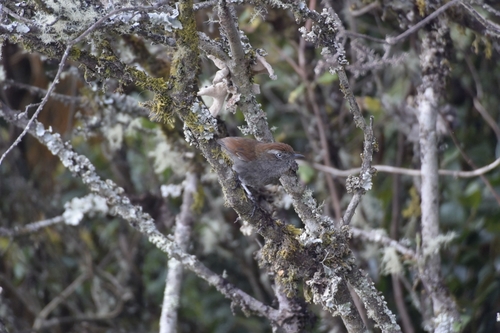
White-chinned Thistletail
Asthenes fuliginosa
The white-chinned thistletail is 18 to 20 cm (7.1 to 7.9 in) long and weighs 14 to 20 g (0.49 to 0.71 oz). It is the largest thistletail. The sexes have the same plumage. Adults of the nominate subspecies A. f. fuliginosa have a faint grayish-tawny supercilium and a whitish eyering on an otherwise blackish to dark brown face. Their crown, back, rump, and tail are dark reddish brown. Their wings are a brighter reddish brown. Their tail is long and deeply forked with few barbs at the feather ends that give a ragged appearance. Their chin is whitish. Voice: One of the white-chinned thistletail's songs is "a high-pitched, weak, slightly accelerating and ascending trill". Others are a "descending series of somewhat higher-pitched notes that accelerates into trill, and a slightly ascending series of tripled notes, 'tididit, tididit, tididit' ". Its calls include "a high-pitched, sharp, penetrating 'pyeek' or 'kick' " and "chink".
ID text from Wikipedia, CC BY-SA 4.0

Where you might meet both
Learn this pair in the BeakBrain App
Photo and call practice. Coming soon to iPhone and Android.
Play today's Daily BirdPhotos and recordings are credited to their authors under the licence shown. Full profiles: Rusty-vented Canastero and White-chinned Thistletail.