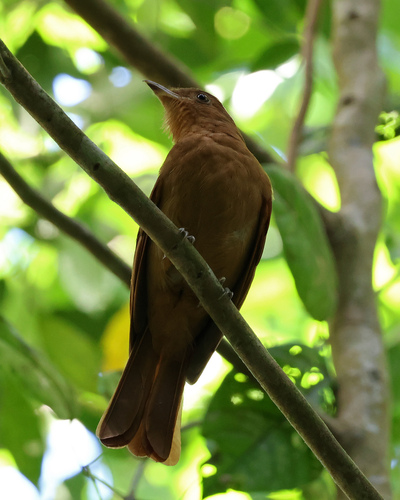
Rufous Piha
Lipaugus unirufus
The rufous piha is 22 to 26 cm (8.7 to 10 in) long; six individuals weighed 79 to 97 g (2.8 to 3.4 oz). The sexes have the same plumage. Adults of the nominate subspecies have a rufous crown with thin, somewhat lighter, streaks. The rest of their face and their upperparts are deep cinnamon brown. Their wings and tail are deep cinnamon brown with deep ochraceous buff inner webs on the remiges. Their underparts are buffy cinnamon that is darker and duller on the breast. Subspecies L. u. castaneotinctus has darker, more chestnut cinnamon upperparts than the nominate. Voice: The calls of the nominate subspecies of the rufous piha are described as "a very loud, scratchy, electric-sounding WIIII'WERRRE! or Peuuur-WIIII'WERRRRE!, or just a single peeuuurr". Those of subspecies L. u. castaneotinctus are similar, "a variety of loud and explosive whistled calls, e.g., peeeéuw, wheeeéo, and chow-eeéo" that are sometimes given in a short series.
ID text from Wikipedia, CC BY-SA 4.0

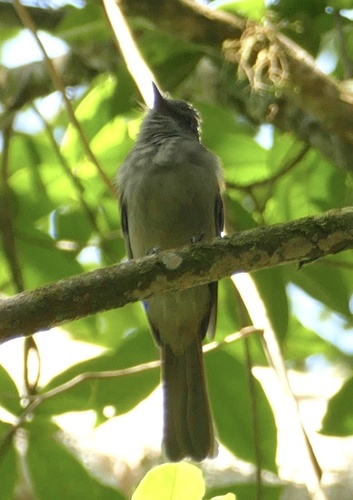
Screaming Piha
Lipaugus vociferans
The screaming piha is 24 to 26 cm (9.4 to 10 in) long and weighs 68 to 87 g (2.4 to 3.1 oz). The sexes have the same plumage. Adults have medium gray upperparts. Their tail and their wings' flight feathers and greater coverts are browner or duskier. Their underparts are a paler gray that is palest on the throat. They have a brown, grayish brown, or gray iris, a black maxilla and a dusky mandible with a pinkish dusky base. Their legs and feet are highly variable with colors that include dark shades of green, brown, gray, and black. Voice: " Screaming Piha is famous for its characteristic qui, qui, yo call, which is audible through up to 400 m of rainforest" and is preceded by two or three fainter groo notes. The song exceeds 110 decibels at one meter, which "translated for human ears a value of loudness between 'discomfort' and 'pain' ".
ID text from Wikipedia, CC BY-SA 4.0

Where you might meet both
Learn this pair in the BeakBrain App
Photo and call practice. Coming soon to iPhone and Android.
Play today's Daily BirdPhotos and recordings are credited to their authors under the licence shown. Full profiles: Rufous Piha and Screaming Piha.