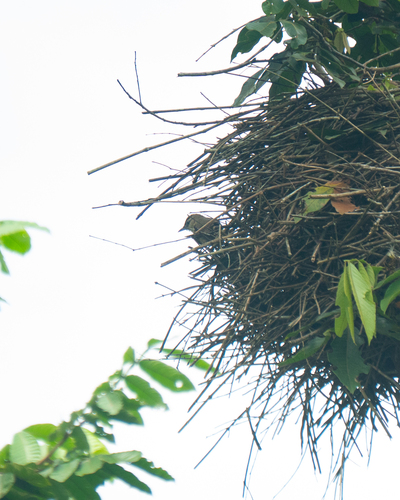
Rufous-fronted Thornbird
Phacellodomus rufifrons
The rufous-fronted thornbird is 16 to 17 cm (6.3 to 6.7 in) long and weighs about 18 to 31 g (0.63 to 1.1 oz). The sexes have the same plumage. Adults of the nominate subspecies P. r. rufifrons have a dull buff supercilium that continues past the eye, a dark brown stripe behind the eye, and dark grayish lores on an otherwise pale buff-brown face. Their forehead ("front") is dark rufous and their crown dark brownish with some paler streaks. Their upperparts are a slightly lighter dark brown. Their wings are mostly dull brown with darker brown primary coverts. Their tail is dull brown. Voice: The rufous-fronted thornbird's song is a "rather unstructured series of very high, mewing 'stjew' notes, rising, falling, and repeating". Its calls include an "extr. high, sharp 'sipsipsip-sip-' " and "a sharp 'chip' or 'chek, or a metallic 'tsi'.
ID text from Wikipedia, CC BY-SA 4.0


Sharp-tailed Streamcreeper
Lochmias nematura
The sharp-tailed streamcreeper is 13 to 14 cm (5.1 to 5.5 in) long and weighs 20 to 38 g (0.71 to 1.3 oz). It is a rather dark furnariid with a long and slightly decurved bill. The sexes' plumages are alike. Adults of the nominate subspecies have a narrow ragged white supercilium, blackish lores, dull brownish ear coverts with rufescent shafts, and a whitish malar area. Their crown is dark brown with faint spots on the forehead. Their back is rich reddish brown that blends to a blackish rump and uppertail coverts. Voice: The sharp-tailed streamcreeper's song appears to vary little among its disjunct populations. The song is "a series of dry notes that gradually accelerate and ascend, then stay on same pitch, then descend abruptly". Its calls have been written as "sea-sick", "seesee-sik", "tsiterit", and "tsitit". Its alarm call is "chet-chet-chet".
ID text from Wikipedia, CC BY-SA 4.0

Where you might meet both
Learn this pair in the BeakBrain App
Photo and call practice. Coming soon to iPhone and Android.
Play today's Daily BirdPhotos and recordings are credited to their authors under the licence shown. Full profiles: Rufous-fronted Thornbird and Sharp-tailed Streamcreeper.