
Rufous-crowned Tody-Flycatcher
Poecilotriccus ruficeps
The rufous-crowned tody-flycatcher is about 9 to 10 cm (3.5 to 3.9 in) long and weighs about 6.6 g (0.23 oz). The sexes have the same plumage. Adults of the nominate subspecies P. r. ruficeps have a bright rufous crown and a gray nape that are separated by a black line that continues onto the cheek. They have a white to buffy area above the lores, a thin black line through the eye, and white to buffy cheeks. Their back, rump, and uppertail coverts are olive. Voice: The rufous-crowned tody-flycatcher's vocalizations are "soft, easily overlooked, and usually given only at well-spaced intervals". Its song has been described as a sputtering "pa-treer-pít-pít-pít" with some variation. Its calls include "a gravelly stuttered 'tttrew', 'pit-tttrew', or 'tttrew-pit', sometimes given as a duet".
ID text from Wikipedia, CC BY-SA 4.0

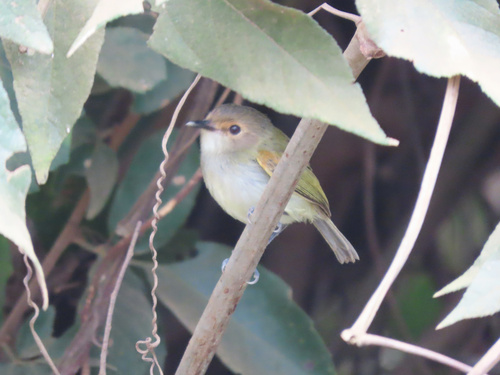
Rusty-fronted Tody-Flycatcher
Poecilotriccus latirostris
The rusty-fronted tody-flycatcher is 9 to 9.5 cm (3.5 to 3.7 in) long and weighs about 7 to 9 g (0.25 to 0.32 oz). The sexes have the same plumage. Adults of the nominate subspecies P. l. latirostris have a brownish gray crown. Their forecrown ("front") and face are rusty-buff that is brightest on the lores and around the eyes. Their back, rump, and uppertail coverts are olive. Their wings are dusky with narrow yellowish edges on the flight feathers and ochraceous tips on the coverts; the latter show as two wing bars. Their tail is dusky. Voice: The rusty-fronted tody-flycatcher's song has been described as "an easily overlooked, insectlike descending trill, low-pitched and rich in quality: tchur'r'r'r'r'r". Its calls are described as "a deep, rich tchup and a rising-falling musical rattled wrr'ee'e'r'r'r'r'r".
ID text from Wikipedia, CC BY-SA 4.0

Where you might meet both
Learn this pair in the BeakBrain App
Photo and call practice. Coming soon to iPhone and Android.
Play today's Daily BirdPhotos and recordings are credited to their authors under the licence shown. Full profiles: Rufous-crowned Tody-Flycatcher and Rusty-fronted Tody-Flycatcher.