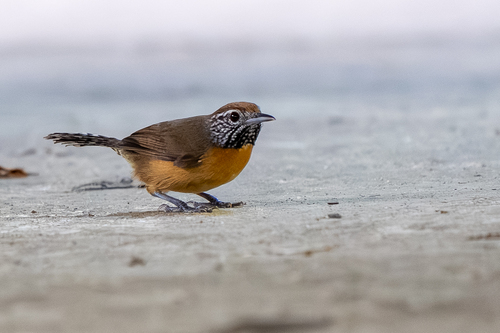
Rufous-breasted Wren
Pheugopedius rutilus
Adult rufous-breasted wrens of the nominate subspecies are 14 cm (5.5 in) long and weigh 13.5 to 18.5 g (0.48 to 0.65 oz). Their crowns and upperparts are warm brown; their tail is gray-brown with heavy dark brown bars. They have a white supercilium with a black edge above it. Their face and throat are speckled black and white. The chest is bright chestnut. The rest of the underparts a duller chestnut with a grayish white center to the belly. Juveniles are duller than the adults and the facial markings are less distinct. The facial pattern and rufous breast are unique in the genus. P. r. Voice: The rufous-breasted wren's songs vary throughout its range. Both sexes sing as a duet but sometimes the male sings alone. Some examples of songs are (Costa Rica) , (Panama) , (Colombia) , (Venezuela) , and (Trinidad) . Its call, "churring and raspy", does not seem to vary as much .
ID text from Wikipedia, CC BY-SA 4.0

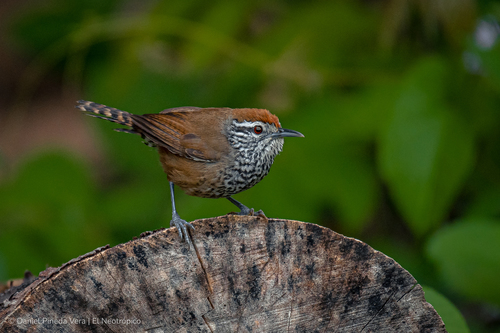
Spot-breasted Wren
Pheugopedius maculipectus
The spot-breasted wren is 12.5 to 14 cm (4.9 to 5.5 in) long; males weigh 14.3 to 16.8 g (0.50 to 0.59 oz) and females 12.4 to 16.2 g (0.44 to 0.57 oz). Adults of the nominate subspecies have a reddish brown crown and upperparts; the rump is more chestnut. Their tail is dull brown with narrow dark bars. They have a white supercilium and the rest of the face and neck are streaked with black and white. The throat, chest, and the center of the belly are pale gray with black spots and the flanks and lower belly are orange-buff with no spots. Voice: The spot-breasted wren's song is " a cheerful series of clear whistling gurgles" given by both sexes .
ID text from Wikipedia, CC BY-SA 4.0

Where you might meet both
Learn this pair in the BeakBrain App
Photo and call practice. Coming soon to iPhone and Android.
Play today's Daily BirdPhotos and recordings are credited to their authors under the licence shown. Full profiles: Rufous-breasted Wren and Spot-breasted Wren.