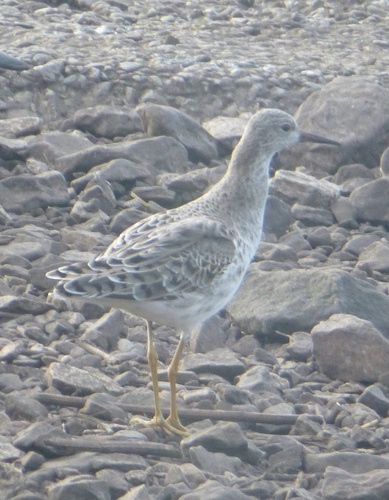
Ruff
Calidris pugnax
The ruff has a distinctive pot-bellied appearance, with a small head, medium-length bill, longish neck and heavy body. It has long legs that are variable in colour, being dark greenish in juveniles, pink to orange in adults with some males having reddish orange legs only during the breeding season. In flight, it has a deeper, slower wing stroke than other waders of a similar size, and displays a thin, indistinct white bar on the wing, and white ovals on the sides of the tail. The species shows sexual dimorphism.
ID text from Wikipedia, CC BY-SA 4.0


Western Sandpiper
Calidris mauri
Adults have dark legs and a short, thin, dark bill, thinner at the tip. The body is brown on top and white underneath. They are reddish-brown on the crown. This bird can be difficult to distinguish from other similar tiny shorebirds, especially the semipalmated sandpiper. This is particularly the case in winter plumage, when both species are plain grey. The western sandpiper acquires winter plumage much earlier in the autumn than the semipalmated sandpiper. Measurements: Length: 14–17 cm (5.5–6.7 in) Wingspan: 35–37 cm (14–15 in) Weight: 22–35 g (0.78–1.23 oz)
ID text from Wikipedia, CC BY-SA 4.0
Where you might meet both
And 1 more countries.
Learn this pair in the BeakBrain App
Photo and call practice. Coming soon to iPhone and Android.
Play today's Daily BirdPhotos and recordings are credited to their authors under the licence shown. Full profiles: Ruff and Western Sandpiper.