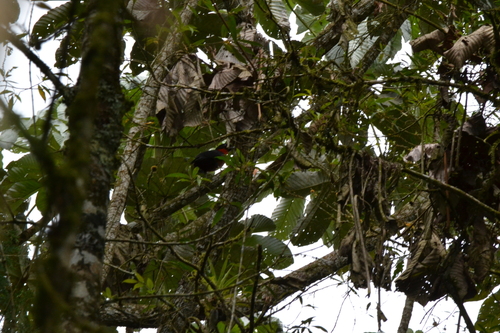
Red-ruffed Fruitcrow
Pyroderus scutatus
It has a relatively heavy pale bluish bill, and the plumage is primarily black, but with a dull brown to bright orange-crimson patch on the throat depending on the subspecies, (thereby superficially resembling the smaller male purple-throated fruitcrow). Some subspecies have brown underparts. Males gather in loose leks where they call to attract the smaller, but otherwise similar, females.
ID text from Wikipedia, CC BY-SA 4.0

Three-wattled Bellbird
Procnias tricarunculatus
One of four species of bellbird that live in Central and South America, the three-wattled bellbird is between 25 cm (9.8 in) and 30 cm (12 in) long. The body, tail, and wings of the male are uniformly chestnut-brown; its head, neck, and upper breast are white; and it has a black eye-ring, eye-stripe, and bill. Its name comes from the three worm-like wattles of skin that hang from the base of the bill. These wattles can be as long as 10 cm (3.9 in) when extended during songs and interactions. The wattles remain flaccid even when extended. Voice: Because of the secretive behavior of this bird, it is often only detected by the distinctive bell-like call given by the males. At close range, the vocalization of many in Costa Rica is heard as a complex three-part song, the "bonk" giving the bird its name. This hollow, wooden "bonk" is thought to be among the loudest bird calls on Earth, audible to humans from over 0.5 mi (0.80 km) away.
ID text from Wikipedia, CC BY-SA 4.0
Learn this pair in the BeakBrain App
Photo and call practice. Coming soon to iPhone and Android.
Play today's Daily BirdPhotos and recordings are credited to their authors under the licence shown. Full profiles: Red-ruffed Fruitcrow and Three-wattled Bellbird.