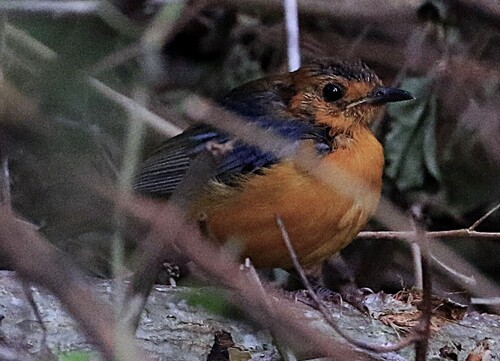
Red-capped Robin-Chat
Cossypha natalensis
The red-capped robin-chat is a relatively large species of robin-chat with a length of 15.5 to 19 cm (6.1 to 7.5 in). The adults have an orange-rufous head, face, breast and belly with a large dark eye. The overall appearance of the head is of a plain face with the dark eye in its centre. The wings and upperparts of the body are dusky and these contrast with the dark central and bright orange outer tail feathers. The juveniles are a mottled dark brown with rufous-brown spots on the head. The upper and underparts have rufous spots, these become larger towards the belly. Voice: The red-capped robin chat has a plaintive, tremulous contact call and has other fluty vocalisations, similar to those of other robin-chats. The song is a long series of melodious whistles with a lot of mimicry included.
ID text from Wikipedia, CC BY-SA 4.0

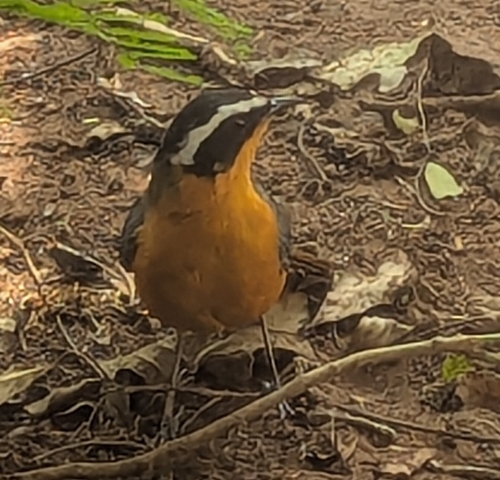
White-browed Robin-Chat
Cossypha heuglini
The white-browed robin-chat is 19–20 cm (7.5–7.9 in) long and weighs 29–51 g (1.0–1.8 oz). The crown and face are black, and there is a white supercilium over the dark brown eye. The back is olive grey-brown, and the rump is rufous. The two central tail feathers are olive-brown, and the other feathers are orange-rufous. The flight feathers and wing coverts are grey-brown, and the underwing coverts are rufous. The underparts are bright orange-rufous. The beak is black, and the legs are pinkish-brown, brownish grey, or dark brown. The female is a little smaller than the male. Voice: The white-browed robin-chat's contact calls include repeated pit-porlee, chiiritter-porlii and da-da-tee and end with da-teee or chickle-ter-tweep. The alarm call is takata-kata-kata. The melodious song, usually given at dawn and dusk, is quiet at first and then becomes louder; it consists of pip-pip-uree, don't-you-do-it or tirrootirree phrases that can be repeated more than ten times.
ID text from Wikipedia, CC BY-SA 4.0

Where you might meet both
Learn this pair in the BeakBrain App
Photo and call practice. Coming soon to iPhone and Android.
Play today's Daily BirdPhotos and recordings are credited to their authors under the licence shown. Full profiles: Red-capped Robin-Chat and White-browed Robin-Chat.