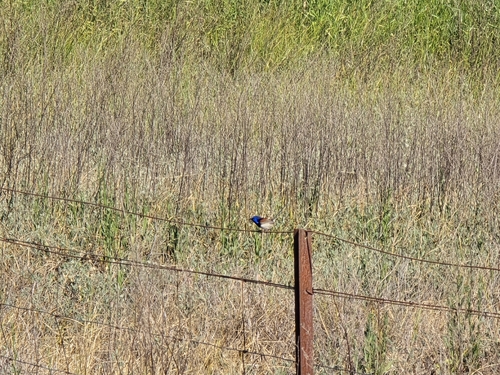
Purple-backed Fairywren
Malurus assimilis
The purple-backed fairywren is on average 14.5 cm (5.5 in) long. Like other fairywrens, it is notable for its marked sexual dimorphism, males adopting a highly visible breeding plumage of brilliant iridescent blue and chestnut contrasting with black and grey-brown. The brightly coloured crown and ear tufts are prominently featured in breeding displays. The male in breeding plumage has striking bright blue ear coverts and blue-purple crown and forehead, a black throat and nape, a blue-purple upper back, chestnut shoulders and a bluish-grey tail. The wings are drab brown and the belly white.
ID text from Wikipedia, CC BY-SA 4.0

Red-backed Fairywren
Malurus melanocephalus
The smallest member of the genus Malurus, the red-backed fairywren measures 11.5 centimetres (4.5 in) and weighs 5–10 g (0.18–0.35 oz), averaging around 8 g (0.28 oz). The tail is approximately 6 centimetres (2.4 in) long and is black in the breeding male, and brown in eclipse males, females, and juvenile birds. Averaging 8.6 mm (0.3 in), the bill is relatively long, narrow, pointed, and wider at the base. Wider than it is deep, the bill is similar in shape to those of other birds that feed by probing or picking insects off of their environs. Voice: The typical song used by the red-backed fairywren to advertise its territory is similar to that of other fairywrens, namely a reel made up of an introductory note followed by repeated short segments of song, starting weak and soft and ending high and shrill with several syllables. The call is mostly made by the male during mating season.
ID text from Wikipedia, CC BY-SA 4.0
Where you might meet both
Learn this pair in the BeakBrain App
Photo and call practice. Coming soon to iPhone and Android.
Play today's Daily BirdPhotos and recordings are credited to their authors under the licence shown. Full profiles: Purple-backed Fairywren and Red-backed Fairywren.