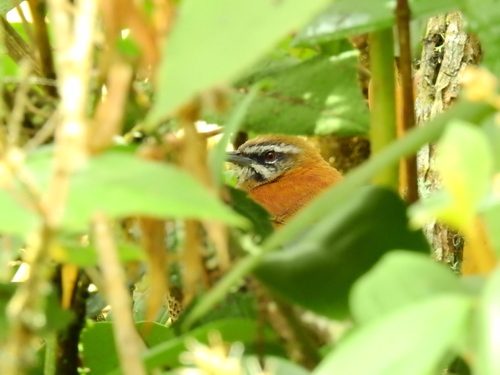
Plain-tailed Wren
Pheugopedius euophrys
Voice: The plain-tailed wren sings a rolling, repetitive song. Singing pairs of plain-tailed wrens coordinate such that the duets between males and females alternate syllables so quickly it sounds as if a single bird is singing. Research finds the brains of both birds process the entire duet, not just each bird's own contribution.
ID text from Wikipedia, CC BY-SA 4.0

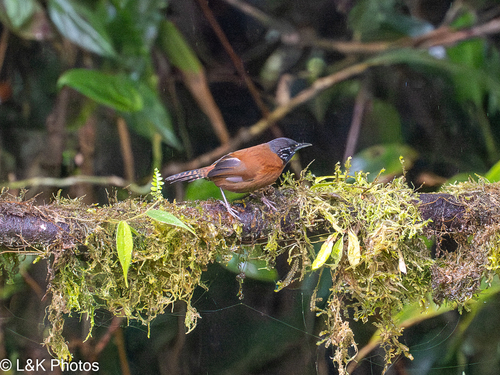
Sooty-headed Wren
Pheugopedius spadix
The sooty-headed wren is 14.5 cm (5.7 in) long. The nominate adults' crown, shoulders, and back are dull blackish and the rump bright chestnut. Their tail is chestnut with bold black bars. Much of their face is black with white streaks. Their chin and throat are black and contrast with the bright chestnut lower throat and chest. The belly is a duller grayish brown between reddish brown flanks. The juvenile is duller than the adult and has less contrast between the areas of different color. P. s. xerampelinus is overall paler than the nominate and has less extensive reddish brown on the flanks. Voice: Both sexes of the sooty-headed wren sing, "a series of...gurgling whistles" .
ID text from Wikipedia, CC BY-SA 4.0
Learn this pair in the BeakBrain App
Photo and call practice. Coming soon to iPhone and Android.
Play today's Daily BirdPhotos and recordings are credited to their authors under the licence shown. Full profiles: Plain-tailed Wren and Sooty-headed Wren.