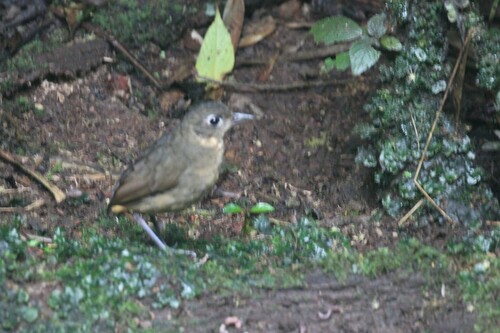
Plain-backed Antpitta
Grallaria haplonota
Grallaria antpittas are a "wonderful group of plump and round antbirds whose feathers are often fluffed up...they have stout bills very short tails". The plain-backed antpitta is 16 to 17 cm (6.3 to 6.7 in) long and weighs 75 to 90 g (2.6 to 3.2 oz). The sexes have the same plumage. Adults of the nominate subspecies G. h. haplonota have a pale buff "moustache" with a dusky stripe below it on an otherwise brown face. Their upperparts are brown with a gray tinge on their crown; their tail is dark rufescent. Voice: The plain-backed antpitta sings from the ground or a low perch. Its song has been described as "a slow, measured of ca. 5-9 low, hollow notes rising slightly in middle" and as "a fairly slow, slightly decelerating, rising-falling, loudest at the highest pitch, series of hooted notes".
ID text from Wikipedia, CC BY-SA 4.0


Undulated Antpitta
Grallaria squamigera
Grallaria antpittas are a "wonderful group of plump and round antbirds whose feathers are often fluffed up...they have stout bills, very short tails, and very long bluish gray legs". The undulated antpitta is the largest member of its genus that occurs in the higher Andes; it is 20 to 24 cm (7.9 to 9.4 in) long and weighs 112 to 174 g (4.0 to 6.1 oz). The sexes have the same plumage. Adults of the nominate subspecies have a gray crown and nape and mostly ashy brown upperparts with a variable olivaceous wash. Most upperparts feathers have darker edges that give a scaly appearance. Voice: The undulated antpitta typically sings from dawn into the early morning and from a low perch. It sings at any time of the year but more frequently during the breeding season. Its song has been compared to the voice of some small owls, "a fast hollow quavering trill that slightly ascends in pitch and lasts 3-4 seconds, e.g. 'hohohohohohohohohohohoho', with last few notes more enunciated".
ID text from Wikipedia, CC BY-SA 4.0

Where you might meet both
Learn this pair in the BeakBrain App
Photo and call practice. Coming soon to iPhone and Android.
Play today's Daily BirdPhotos and recordings are credited to their authors under the licence shown. Full profiles: Plain-backed Antpitta and Undulated Antpitta.