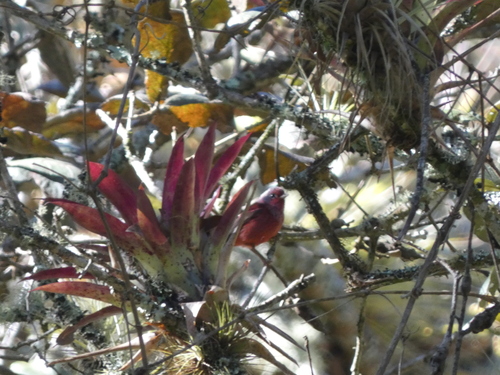
Pink-headed Warbler
Cardellina versicolor
The pink-headed warbler measures 12.5–13.5 cm (4.9–5.3 in) in length, and weighs 10 g (0.35 oz). Both sexes have a similar plumage, though females are, on average, slightly duller overall. The adult has dark red upperparts, a silvery-pink chest and pinkish-red underparts. Its head is silvery-pink, with a reddish forehead, dusky lores and dark brown irises. Its bill is blackish, sometimes showing some horn color on the lower mandible, and its legs are flesh-colored. The juvenile is a rich brown with slightly paler underparts. However, that plumage is quickly molted. Voice: The pink-headed warbler's call is high, thin, and somewhat metallic, variously transcribed as tsiu, ssing or tseeip. It also has a low, weak chip that it uses to stay in contact with its mate. Its song is a series of short trills and chips, described as being "clear and cheery" and reminiscent of the song of the yellow warbler, as well as slower and less varied than that of the red warbler.
ID text from Wikipedia, CC BY-SA 4.0
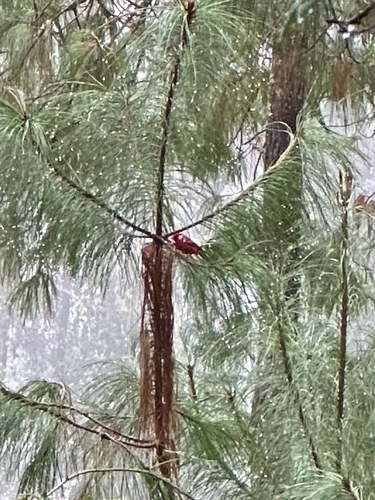
Red Warbler
Cardellina rubra
The red warbler is a small passerine, measuring 12.5–13.5 cm (4.9–5.3 in) in length, and weighing from 7.6 to 8.7 g (0.27 to 0.31 oz). As an adult, it is red overall, with either a white or dark gray (depending on the subspecies) auricular patch on each side of its head. Its wings and tail are slightly darker, dusky red, and edged in pinkish-red. Its legs are a dull red-brown, and its thin bill is pinkish-gray with a dark tip. The iris is dark brown to blackish. Plumage varies little between the sexes, although the female tends to be a little duller or more orange-tinged. Voice: The red warbler has several common calls, including a high, thin tsii and a stronger pseet. Its song is a mix of short trills and richer warbles, interspersed with high-pitched chips. Unlike other species in the same habitat zone, it tends to sing only during bright morning hours during the breeding season.
ID text from Wikipedia, CC BY-SA 4.0
Where you might meet both
Learn this pair in the BeakBrain App
Photo and call practice. Coming soon to iPhone and Android.
Play today's Daily BirdPhotos and recordings are credited to their authors under the licence shown. Full profiles: Pink-headed Warbler and Red Warbler.