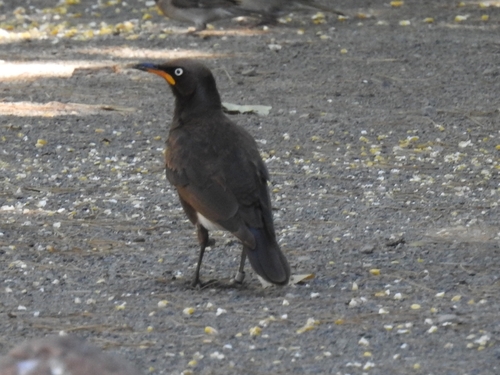
Pied Starling
Lamprotornis bicolor
The adult of this 27–28 cm (11 in) long starling has mainly dully glossed black plumage except for a white lower belly and undertail. It has a white iris and yellow lower mandible. The sexes are alike, but the juvenile has unglossed plumage, a brown iris and a dull yellow lower mandible. There are no subspecies. This species has a number of calls, but the most familiar is a skeer kerrra kerrra. There is also a soft warbling song.
ID text from Wikipedia, CC BY-SA 4.0
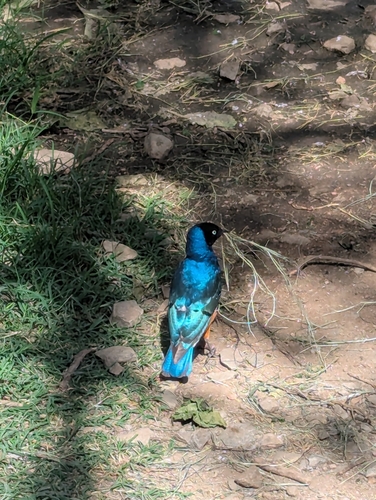
Superb Starling
Lamprotornis superbus
This species is 18 to 19 cm (7.1 to 7.5 in) in height. These small short-tailed starlings have a long narrow bill, robust bodies, strong feet and a distinctive plumage pattern. Their spectacular iridescent plumage is due to the arrangement of melanin granules within the feathers, resulting in structural blues and greens, rather than colors derived from pigments. The appearance of the superb starling is very similar to the Hildebrandt's starling, also found in East Africa. The superb starling is distinguished by having pale creamy-white eyes, as opposed to red eyes in the Hildebrandt's. Voice: The superb starling has a long and loud song consisting of trills and chatters. At midday it gives a softer song of repeated phrases. There are several harsh calls, the most complex, which is described as "a shrill, screeching skerrrreeee-cherrrroo-tcherreeeeeet." Additionally, superb starlings produce warning chirr and a reapeated whit-chor-chi-vii when they are excited.
ID text from Wikipedia, CC BY-SA 4.0

Learn this pair in the BeakBrain App
Photo and call practice. Coming soon to iPhone and Android.
Play today's Daily BirdPhotos and recordings are credited to their authors under the licence shown. Full profiles: Pied Starling and Superb Starling.