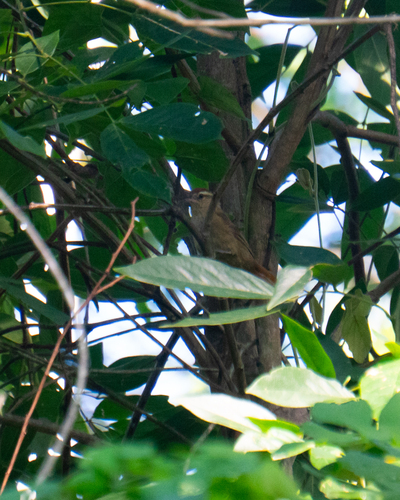
Pallid Spinetail
Cranioleuca pallida
The pallid spinetail is 14 to 15 cm (5.5 to 5.9 in) long and weighs 11 to 12 g (0.39 to 0.42 oz). It is a smallish member of genus Cranioleuca. The sexes have the same plumage. Adults have a wide whitish supercilium, a blackish spot in front of the eye, a dark brown band behind the eye, and buffy ear coverts with faint dark brownish streaks. Their forehead is streaked blackish and buff, their crown is dark rufous, and their nape gray. Their back and rump are tawny-olive or olive-brown. Their tail is dark rufous; the feathers are graduated and lack barbs at the end giving a spiky appearance. Voice: The pallid spinetail's song is an "extr. high, slightly descending series of about 5 'seetseet---tut' notes (often accelerated to a trill at the end)". Its call is "tééé-ssik, tséé-ssik".
ID text from Wikipedia, CC BY-SA 4.0

Stripe-crowned Spinetail
Cranioleuca pyrrhophia
The stripe-crowned spinetail is 13 to 16 cm (5.1 to 6.3 in) long and weighs 10 to 16 g (0.35 to 0.56 oz). It is a smallish member of genus Cranioleuca and has unique crown and tail patterns. The species shows considerable plumage variation following Gloger's rule. The sexes have the same plumage. Adults of the nominate subspecies have a wide white supercilium, dark brown lores, dark brown behind the eye, and mixed whitish and brown ear coverts. Their crown is dramatically striped with blackish and buffy brown; the stripes are fainter in southern Brazil and Paraguay. Voice: One song of the stripe-crowned spinetail is "an accelerating, descending trill without introductory notes" also described as "an accelerating tee teetee titititit... ending in a trill. Another is a "few widely spaced metallic 'tick' notes followed by rapid series of high, descending, bubbly, clicking 'chack' notes". Its calls include a "soft, metallic 'tck' or rapid 'tidrrit' " and "wrrru".
ID text from Wikipedia, CC BY-SA 4.0
Where you might meet both
Learn this pair in the BeakBrain App
Photo and call practice. Coming soon to iPhone and Android.
Play today's Daily BirdPhotos and recordings are credited to their authors under the licence shown. Full profiles: Pallid Spinetail and Stripe-crowned Spinetail.