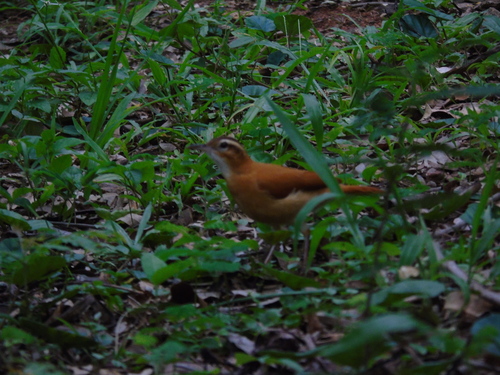
Pale-legged Hornero
Furnarius leucopus
The pale-legged hornero is 15 to 18 cm (5.9 to 7.1 in) long and weighs about 37 to 49 g (1.3 to 1.7 oz). It is a medium-sized hornero with a long and nearly straight bill. The sexes' plumages are alike. Adults of the nominate subspecies F. l. leucopus have a wide whitish supercilium, brownish gray ear coverts, and a tawny-rufous malar area. Their crown is dark rufescent brown. Their back, rump, and uppertail coverts average bright orange rufous but vary between tawny rufous and rufous amber. Their tail is chestnut. Voice: The pale-legged hornero's song is a "long series of loud, explosive, piercing, staccato notes, which decelerates and descends in pitch...rendered PIPIPI'PI'pi'pi-pi-pi-pi-pi pee pee pu". Its calls are "a loud, rich, scratchy or reedy chet or kyeek, or a descending cheeop".
ID text from Wikipedia, CC BY-SA 4.0


Wren-like Rushbird
Phleocryptes melanops
The wren-like rushbird is 13 to 14 cm (5.1 to 5.5 in) long and weighs 11 to 16 g (0.39 to 0.56 oz). It is a small furnariid whose plumage closely resembles that of the wholly unrelated marsh wren (Cistothorus palustris). It has a longish slightly decurved bill. The sexes' plumages are essentially alike though females are slightly paler than males. Adults of the nominate subspecies P. m. melanops have a wide buff supercilium, grayish lores, a dark brown band behind the eye, mottled dark brown ear coverts, and a buff malar area. Their crown is blackish with wide brown streaks. Voice: In much of its range, the wren-like rushbird's song is a "repeated mechanical ticking, repeated several times per second, sometimes for several minutes, often ending with trill like that of cicada". One author describes it as sounding "like an idling motor, with the throttle occasionally opened". The song of the Andean population is "similar but with more strident tones".
ID text from Wikipedia, CC BY-SA 4.0
Where you might meet both
Learn this pair in the BeakBrain App
Photo and call practice. Coming soon to iPhone and Android.
Play today's Daily BirdPhotos and recordings are credited to their authors under the licence shown. Full profiles: Pale-legged Hornero and Wren-like Rushbird.