
Painted Honeyeater
Grantiella picta
Weighing around 20-25g, the painted honeyeater is a small bird that is approximately 16 cm in length, with a similar wingspan. Of the total length, the tail averages about 5.5 cm long and the bill 1.3 cm. The face, crown and upper parts of the body (including the scapulars, nape and rump) on adult male birds are black, with small white spots located on either side of the head. The underside of the body, consisting of the chin, throat, breast and belly, as well as the underside of the tail, is white. Black spots may be present in amongst the white feathers of the flanks, breast and belly. Voice: Commonly known to give the call "Georgie", which is broken into two notes, for example geor-gie or georg-EEE. This can also be done in reverse. Males can be particularly vocal during courtship and both sexes are known to call when in flight during the breeding season as they leave and approach the nest.
ID text from Wikipedia, CC BY-SA 4.0
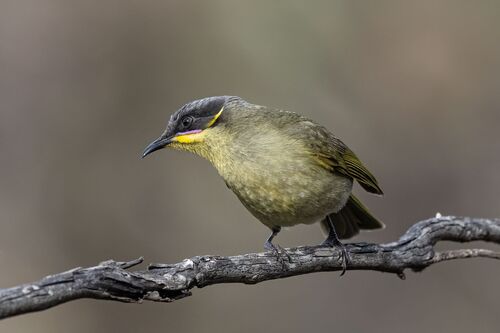
Purple-gaped Honeyeater
Lichenostomus cratitius
The purple-gaped honeyeater is a medium-sized (16-19 centimetres) honeyeater which is generally grey-olive above and buffish yellow below. They have a patterned head, with a black eyestripe against a grey background and purple gape above a yellow streak on the throat and pointed yellow ear coverts. Juveniles are similar, but with duller facial patterns, slightly browner plumage, and a yellow gape and gape line. The Kangaroo Island subspecies is considered to be larger and darker than the mainland subspecies. Similar species include yellow-plumed honeyeater and singing honeyeater. Voice: The song is a clear toweet-toweet-toweet, followed by a high-pitched yep-yep-yep, often performed from a tall branch, including before dawn.
ID text from Wikipedia, CC BY-SA 4.0
Where you might meet both
Learn this pair in the BeakBrain App
Photo and call practice. Coming soon to iPhone and Android.
Play today's Daily BirdPhotos and recordings are credited to their authors under the licence shown. Full profiles: Painted Honeyeater and Purple-gaped Honeyeater.