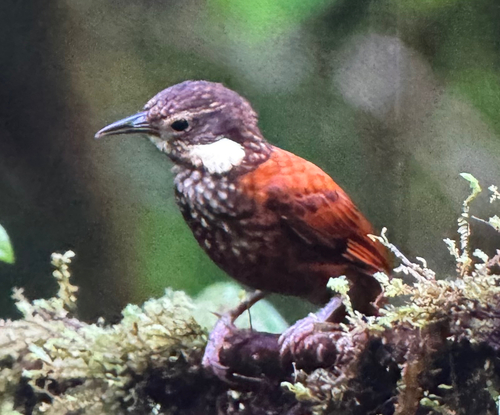
Pacific Tuftedcheek
Pseudocolaptes johnsoni
The Pacific tuftedcheek is 20 to 21 cm (7.9 to 8.3 in) long and weighs about 58 g (2.0 oz). It is a rather large and strongly patterned ovenbird. The sexes' plumages are alike but the female has a significantly longer bill than the male. The species' most distinctive feature is its namesake pale tawny tuft of feathers that flare on the side of the neck. Adults have a buff-whitish supercilium and blackish brown lores and ear coverts. Their crown is blackish brown with many thin buff streaks, their hindcrown similar with wider streaks, and the rest of their back rufous and unstreaked. Voice: The Pacific tuftedcheek sings mainly in the breeding season, a "high-pitched trilled series of notes slowing into stuttering and ending with a characteristic high-pitched downslurred sibilant note...chi'ch't't't't'e'e'bzzzuuu". It usually sings the phrase one time but occasionally repeats it several times.
ID text from Wikipedia, CC BY-SA 4.0

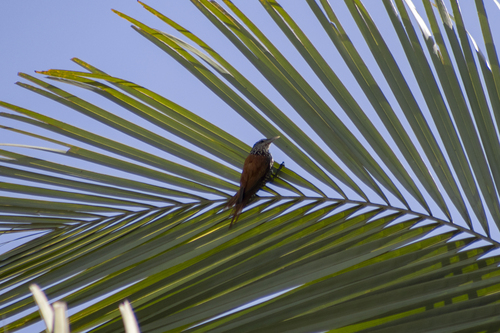
Point-tailed Palmcreeper
Berlepschia rikeri
Ridway says of the point-tailed palmcreeper, "This handsome species, of very striking appearance, is entirely different in coloration from any Dendrocolaptine bird with which I am acquainted". The point-tailed palmcreeper is 18 to 22 cm (7.1 to 8.7 in) long and weighs 32 to 37 g (1.1 to 1.3 oz). The sexes are alike. Adults have a face with thin black and white streaks. Its crown and upper back are also streaked black and white; the streaks become "teardrops" on the back. Its lower back, rump, and uppertail coverts are bright chestnut. Voice: The point-tailed palmcreepers song is "a loud series of 20–30 staccato, strident notes, on same pitch or ascending slightly and then descending at end". It has been put into words as "ka-koo, didididididididididi", "dedede-kee!-kee!-kee!-kee!-kee!-kee!-kee!-kee!", and "weet-weet-witwitwit---".
ID text from Wikipedia, CC BY-SA 4.0
Where you might meet both
Learn this pair in the BeakBrain App
Photo and call practice. Coming soon to iPhone and Android.
Play today's Daily BirdPhotos and recordings are credited to their authors under the licence shown. Full profiles: Pacific Tuftedcheek and Point-tailed Palmcreeper.