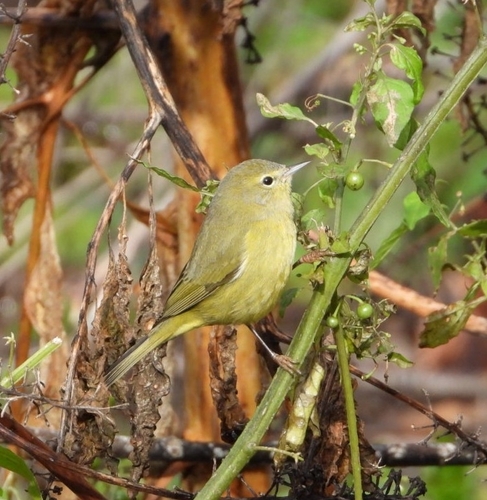
Orange-crowned Warbler
Leiothlypis celata
The orange-crowned warbler has olive-grey upperparts, yellowish underparts with faint streaking and a thin pointed bill. It has a faint line over each eye and a faint broken eye ring. The orange patch on the crown is usually not visible. Females and immatures are duller in colour than males. Western birds are yellower than eastern birds.
ID text from Wikipedia, CC BY-SA 4.0

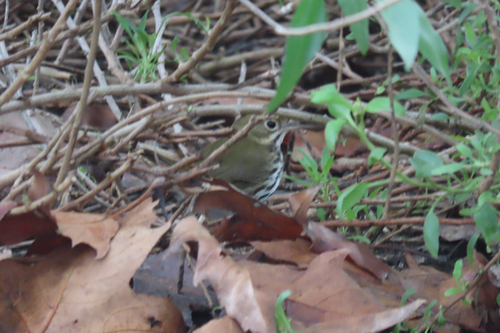
Ovenbird
Seiurus aurocapilla
Ovenbirds are large wood warblers and may sometimes be confused by the untrained for a thrush. Adults measure 11–16 cm (4.3–6.3 in) long and span 19–26 cm (7.5–10.2 in) across the wings. They weigh 19 g (0.67 oz) on average, with a range of 14–28.8 g (0.49–1.02 oz). Among standard measurements, the wing chord is 6.8 to 8.3 cm (2.7 to 3.3 in), the tail is 5 to 5.8 cm (2.0 to 2.3 in), the bill is 1.1 to 1.3 cm (0.43 to 0.51 in) and the tarsus is 2 to 2.3 cm (0.79 to 0.91 in). They tend to be heavier in winter and particularly at the start of their migration. Voice: The main song of the ovenbird is a series of strident, relatively low-pitched, bisyallabic motives repeated without pause about eight times and increasing in volume. Usually, the second syllable in each motive is sharply accented: "chur-tee' chur-tee' chur-tee' chur-tee' chur-TEE chur-TEE chur-TEE!
ID text from Wikipedia, CC BY-SA 4.0

Where you might meet both
Learn this pair in the BeakBrain App
Photo and call practice. Coming soon to iPhone and Android.
Play today's Daily BirdPhotos and recordings are credited to their authors under the licence shown. Full profiles: Orange-crowned Warbler and Ovenbird.