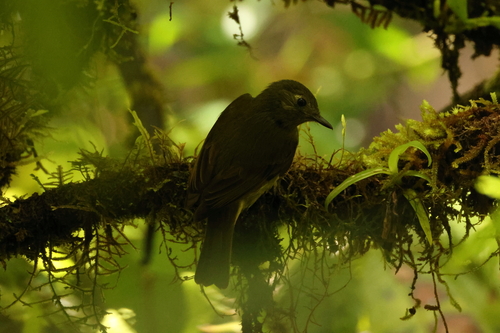
Olive-striped Flycatcher
Mionectes olivaceus
The olive-streaked flycatcher is 13 cm (5.1 in) long. The sexes have the same plumage. Adults have a dark olive face with white streaks and a small triangular white spot behind the eye. Their crown and nape are dark olive and the rest of their upperparts are warm yellow green. Their wings and tail are dusky olive. Their throat and upper breast have dense dark olive and yellowish white streaking with thinner white streaks. Their lower breast and flanks are streaked with dark olive and yellow and their belly is unstreaked yellow. Voice: The olive-streaked flycatcher is mostly silent outside the breeding season. It usually sings the most at dawn, and usually low to the ground in dense vegetation. Its song is an "extremely high-pitched (c 8-10 kHz), prolonged series of extremely fast tinkling notes, descending and ascending in an undulating pattern over the length of the song". Its call is "a very high-pitched (c7.3-9.
ID text from Wikipedia, CC BY-SA 4.0


Streak-necked Flycatcher
Mionectes striaticollis
The streak-necked flycatcher is 13 to 13.5 cm (5.1 to 5.3 in) long and weighs 13 to 17 g (0.46 to 0.60 oz). The sexes have the same plumage. Adults of the nominate subspecies M. s. striaticollis have a dark gray face with white streaks and a small white spot behind the eye. Their crown and nape are slaty gray and the rest of their upperparts are dark olive. Their wings and tail are olive, sometimes with faint buffish olive wing bars. Their throat and upper breast are slate-gray with white streaks. Their lower breast and flanks are streaked with dark olive and yellow and their belly is yellow. Voice: The streak-necked flycatcher apparently sings almost solely at the lek. Its song is variously described as "a series of rhythmic, squeaky notes" and as "a melancholy, squeaky, rising-falling note" urrEEew".
ID text from Wikipedia, CC BY-SA 4.0

Where you might meet both
Learn this pair in the BeakBrain App
Photo and call practice. Coming soon to iPhone and Android.
Play today's Daily BirdPhotos and recordings are credited to their authors under the licence shown. Full profiles: Olive-striped Flycatcher and Streak-necked Flycatcher.