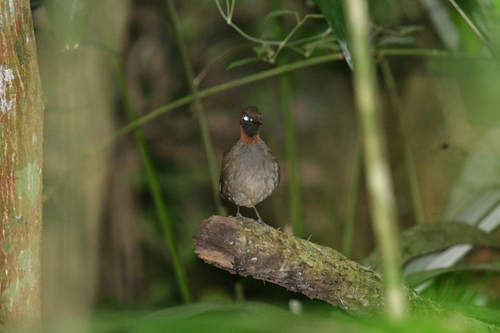
Mayan Antthrush
Formicarius moniliger
The Mayan antthrush is 15 to 19 cm (5.9 to 7.5 in) long and weighs about 56 to 64 g (2.0 to 2.3 oz). The sexes have the same plumage. Adults of the nominate subspecies have a dusky brown crown. They have a small white spot on their lores and bare bluish skin around their eye. Their face from their bill to their eye is black that extends down to include the chin and throat. The sides of their neck are rufous that continues across under the black throat. Their nape, back, rump, and uppertail coverts are brown with a rufescent tinge on the last. Voice: The Mayan antthrush's song "begins with a single introductory whistle followed, after a short pause, by a series of 8–14 whistles at a flat pitch, or alternatively gradually increasing or decreasing in pitch piu...piupiupiupiupiupiupiupiupiu!". There appears to be some regional variation in the song. Both sexes sing, primarily in the morning and late afternoon.
ID text from Wikipedia, CC BY-SA 4.0

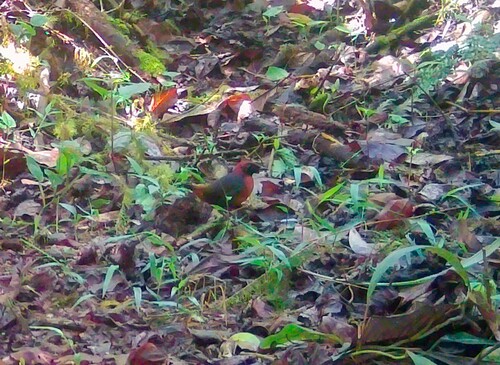
Rufous-breasted Antthrush
Formicarius rufipectus
The rufous-breasted antthrush is 18 to 19 cm (7.1 to 7.5 in) long. Males weigh 70 to 78 g (2.5 to 2.8 oz) and females 65 to 82 g (2.3 to 2.9 oz). The sexes have the same plumage. Adults of the nominate subspecies F. r. rufipectus have a dark chestnut crown, nape, and sides of their neck. Their face and throat are blackish with a bluish white ring of bare skin around their eye. Their back and wings are dark brown, their rump and uppertail coverts dark rufescent brown, and their tail blackish. Their flight feathers have dusky inner edges and a wide cinnamon band at the base. Voice: The rufous-breasted antthrush's song varies somewhat among the subspecies. It is "two clear whistles at 1·8–2 kHz, 'toot-toot', second note sometimes slightly higher-pitched in rufipectus, usually so in carrikeri. The species' call is "a double-noted chirp" written by one author as "TU'TCHOOP".
ID text from Wikipedia, CC BY-SA 4.0

Learn this pair in the BeakBrain App
Photo and call practice. Coming soon to iPhone and Android.
Play today's Daily BirdPhotos and recordings are credited to their authors under the licence shown. Full profiles: Mayan Antthrush and Rufous-breasted Antthrush.