
Marsh Sandpiper
Tringa stagnatilis
The marsh sandpiper resembles a small elegant greenshank, with a long fine bill and very long yellowish legs. Like the greenshank, it is greyish brown in breeding plumage, paler in winter, and has a white wedge up its back that is visible in flight. However, it is more closely related to the common redshank and the wood sandpiper. Together, they form a group of smallish shanks which tend to have red or reddish legs, and in breeding plumage are generally a subdued, light brown above with some darker mottling, with a pattern of somewhat diffuse small brownish spots on the breast and neck.
ID text from Wikipedia, CC BY-SA 4.0
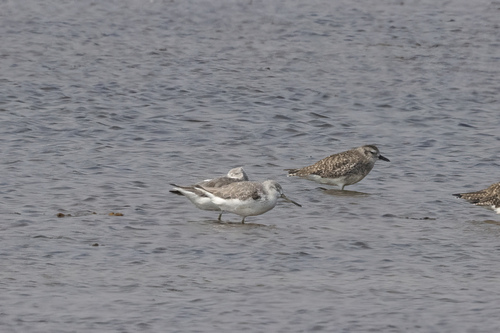
Nordmann's Greenshank
Tringa guttifer
Nordmann's greenshank is a medium-sized sandpiper, at 29–32 cm (11–13 in) long, with a slightly upturned, bicoloured bill, and relatively short yellow legs. Breeding adults have darker plumage than their non-breeding counterparts. These adults often appear boldly marked, with dark brown spangling on their back, chest, and head and a white underbelly.They have a heavily streaked head and upper neck; broad, blackish, crescentic spots on lower neck and breast; and darker lores. Breeding adult bills are darker and less obviously bicolored as well.
ID text from Wikipedia, CC BY-SA 4.0
Where you might meet both
Learn this pair in the BeakBrain App
Photo and call practice. Coming soon to iPhone and Android.
Play today's Daily BirdPhotos and recordings are credited to their authors under the licence shown. Full profiles: Marsh Sandpiper and Nordmann's Greenshank.