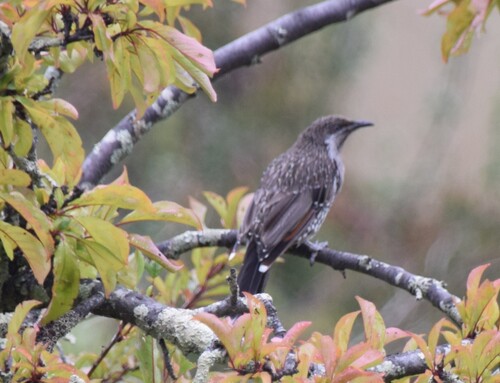
Little Wattlebird
Anthochaera chrysoptera
The little wattlebird is a medium to large honeyeater, but the smallest wattlebird. The appearance is similar to the yellow wattlebird and the red wattlebird. The little wattlebird lacks the wattles, which characterise other members of the genus. Juveniles are duller with less streaking and have a browner eye. Calls include a strident cookay-cok, a raucous fetch the gun, a mellow guttural yekkop, yekkop and many squeaky, musical lilting notes. The alarm call is a kwock or shnairt!.
ID text from Wikipedia, CC BY-SA 4.0
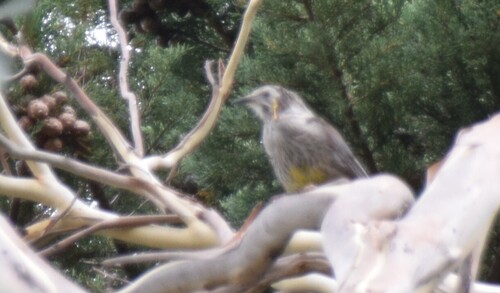
Yellow Wattlebird
Anthochaera paradoxa
The yellow wattlebird is the largest of the honeyeaters, and is endemic to Tasmania. They are usually 37.5–45 centimetres (14.8–17.7 in) long. Body mass in males averages 168 g (5.9 oz) and in females averages 123 g (4.3 oz), with the largest males weighing up to 260 g (9.2 oz). They are named for the wattles hanging from the cheeks. Yellow wattlebirds are slim birds with a short, strong bill. They have a white face and black-streaked crown. They also have a long, pendulous yellow-orange wattle. The wattle becomes brighter during the breeding season.
ID text from Wikipedia, CC BY-SA 4.0
Where you might meet both
Learn this pair in the BeakBrain App
Photo and call practice. Coming soon to iPhone and Android.
Play today's Daily BirdPhotos and recordings are credited to their authors under the licence shown. Full profiles: Little Wattlebird and Yellow Wattlebird.