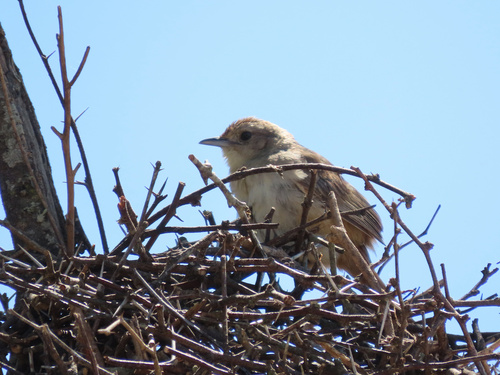
Little Thornbird
Phacellodomus sibilatrix
The little thornbird is 13 to 14 cm (5.1 to 5.5 in) long and weighs about 14 to 16 g (0.49 to 0.56 oz). It is the smallest member of its genus. The sexes have the same plumage. Adults have a wide dull buff-whitish supercilium that extends beyond the eye and an indistinct dull brown stripe behind the eye on an otherwise light brownish face. Their forehead is light rufous with pale streaks, their crown and back dull brown, and their rump and uppertail coverts rufescent-tinged brown. Their wings are mostly shades of brown with darker brown primary coverts and some rufescence. Voice: The little thornbird's song is "a duetted series of sharp, piercing, loud and straight tee tee tees, where one bird goes faster than the other (three notes for two) so the effect is a tee teeter tee teeter teeter tee tee teeter...". Its call is "a sharp 'chip', often repeated".
ID text from Wikipedia, CC BY-SA 4.0


Orange-eyed Thornbird
Phacellodomus erythrophthalmus
The orange-eyed thornbird is 16 to 18 cm (6.3 to 7.1 in) long and weighs about 21 to 27 g (0.74 to 0.95 oz). It is a medium-sized thornbird. The sexes have the same plumage. Adults have an indistinct rufous-brown supercilium, darker brown lores, and a darker brown stripe behind the eye on an otherwise rufescent-brownish face. Their forehead and forecrown are bright rufous. The rest of their crown, their back, and their rump are dark brownish olive, and their uppertail coverts a chestnut-tinged brownish olive. Voice: The orange-eyed thornbird's song is a "slow, descending series of up to 15 sharp, ringing tones". It has also been described as "a series of introductory notes on same pitch followed by descending series of loud notes, 'chree, chree, chree-tsrééeh-tsrééeh-tsrééeh' ". It is usually sung from a perch and sometimes as a duet by a pair.
ID text from Wikipedia, CC BY-SA 4.0
Where you might meet both
Learn this pair in the BeakBrain App
Photo and call practice. Coming soon to iPhone and Android.
Play today's Daily BirdPhotos and recordings are credited to their authors under the licence shown. Full profiles: Little Thornbird and Orange-eyed Thornbird.