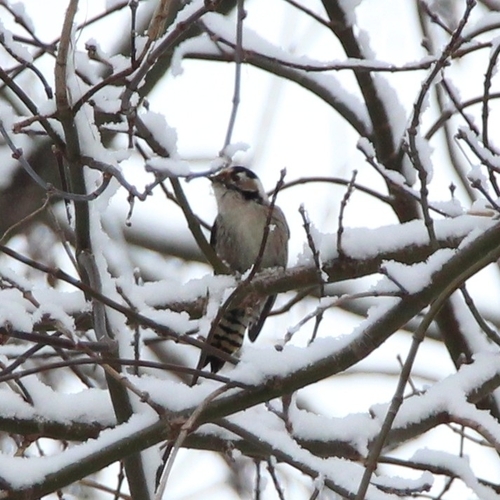
Lesser Spotted Woodpecker
Dryobates minor
This is the smallest European woodpecker, with adults being 14 to 16.5 cm (5.5 to 6.5 in) long with a wing span of 24 to 29 cm (9.4 to 11.4 in) and weighing 17 to 25 g (0.60 to 0.88 oz). A sample of 50 lesser spotted woodpeckers in Great Britain averaged 19.8 g (0.70 oz) in body mass. From its small size and its habit of spending most of its time in the tops of tall trees in woods and parks, this little woodpecker is often overlooked, but if sighted on a trunk it may at once be identified by the broad barring on the wings and narrower bars across the lower back.
ID text from Wikipedia, CC BY-SA 4.0


Nuttall's Woodpecker
Dryobates nuttallii
Nuttall's woodpecker has striped black and white patterned wings and tail feathers with white. Its undercarriage is a primarily white coat with a few spotted black regions. It has a black forehead with white streaks on the sides and an unbarred black region at the top of the back. Adult males have a distinguishable red crown which females do not. However, this physical feature is present in the juvenile of both sexes. Juvenile birds look nearly identical to adults, excluding that juveniles typically have some white color in the form of streaks on their heads. Voice: Vocalizations performed by Nuttall's woodpecker are considered to be not of any harmonic. Some vocalizations have been described: Call note: used between mated pairs to communicate their location to each other. Double call: same function as call note can but also be used as a low threat alarm call.
ID text from Wikipedia, CC BY-SA 4.0

Learn this pair in the BeakBrain App
Photo and call practice. Coming soon to iPhone and Android.
Play today's Daily BirdPhotos and recordings are credited to their authors under the licence shown. Full profiles: Lesser Spotted Woodpecker and Nuttall's Woodpecker.