
Lesser Kiskadee
Philohydor lictor
The lesser kiskadee is 15 to 18 cm (5.9 to 7.1 in) long and weighs about 25 g (0.88 oz). The sexes have the same plumage; females are slightly smaller than males. Adults of the nominate subspecies have a black or sooty crown and face with a mostly hidden bright yellow patch in the center of the crown. They have a wide white supercilium that begins at the forehead and wraps almost all the way around the nape. They have mostly plain olive upperparts with grayish brown to dark olive uppertail coverts. Their wings are dark grayish brown with pale cinnamon or rufous edges on the flight feathers. Voice: The lesser kiskadee's calls include "a vigorous, buzzy, rather nasal dzay or dzweey", a "more prolonged dzay-dzwey-dwzee-zwee", and "keekzi-deeée, queé-be and dree, dear-wrr". "artners also give chattery ca-déde in greeting."
ID text from Wikipedia, CC BY-SA 4.0

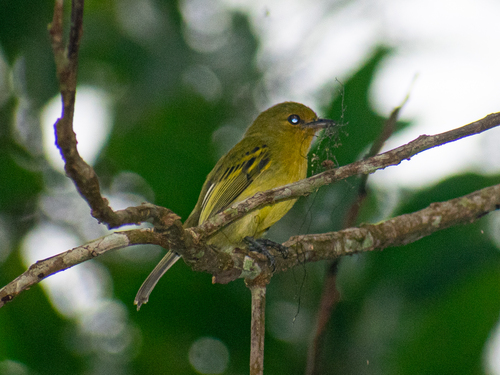
Ochre-lored Flatbill
Tolmomyias flaviventris
The ochre-lored flatbill is about 12 to 13 cm (4.7 to 5.1 in) long and weighs 9 to 17.5 g (0.32 to 0.62 oz). The sexes have the same plumage. Adults of the nominate subspecies have a yellowish olive head with a brighter ochre-tinged stripe above the lores and a brighter ochre-tinged eye-ring. Their back, rump, and uppertail coverts are yellowish olive. Their wings are dusky with yellowish edges on the coverts and remiges that appear as two wing bars. Their tail is dusky. Their underparts are bright yellow with an olive to ochre wash on the throat and breast and lightly on the belly. Voice: The ochre-lored flatbill sings "3-5 rather loud, penetrating whistles, sweeEP!....sweeEP!.....sweeEP!, with pauses of 1-several sec between notes". Its call is "a single sweeEP!". It also makes a "mid-high, short fddddddddfit rattle". It usually sings from a well-hidden perch in the forest canopy, and usually around dawn.
ID text from Wikipedia, CC BY-SA 4.0

Where you might meet both
Learn this pair in the BeakBrain App
Photo and call practice. Coming soon to iPhone and Android.
Play today's Daily BirdPhotos and recordings are credited to their authors under the licence shown. Full profiles: Lesser Kiskadee and Ochre-lored Flatbill.