
Kentucky Warbler
Geothlypis formosa
Adult Kentucky warblers are mostly an olive-green in color on their back and nape, and a brilliant yellow below from their throat to their belly. They have a small tinge of black on their crown, and a large black mask with a yellow pattern that runs from the beak and encircles the eyes, resembling a pair of spectacles. Female Kentucky warblers have slightly less black on the sides of their head, and immature birds may have almost no black at all. Measurements: Length: 5.1 in (13 cm) Weight: 0.5–0.5 oz (13–14 g) Wingspan: 7.9–8.7 in (20–22 cm)
ID text from Wikipedia, CC BY-SA 4.0

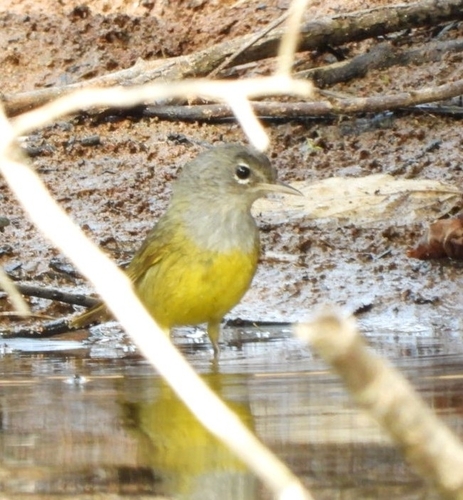
MacGillivray's Warbler
Geothlypis tolmiei
MacGillivray's warbler is 10 to 15 cm (3.9 to 5.9 in) long, weighs 9 to 13 g (0.32 to 0.46 oz), and has a wingspan of 19 cm (7.5 in). Adult males of the nominate subspecies have a mostly medium gray head and nape that often has a brownish or olive wash. They have darker gray to blackish lores and line through the eye and wide white crescents above and below the eye. Their back, rump, and uppertail coverts are yellowish olive-green. Their wings and tail are blackish brown with olive-green feather edges. Their throat and upper breast are medium gray, often with a brownish wash. Voice: The primary song of male MacGillivray's warbler is "6-8 syllables described as churry churry churry churry cheery cheery". Both sexes make calls, "a harsh chip note" and "a high-frequency chip". Males sing mostly at dawn and dusk, typically from a high perch.
ID text from Wikipedia, CC BY-SA 4.0
Where you might meet both
Learn this pair in the BeakBrain App
Photo and call practice. Coming soon to iPhone and Android.
Play today's Daily BirdPhotos and recordings are credited to their authors under the licence shown. Full profiles: Kentucky Warbler and MacGillivray's Warbler.