
Jungle Owlet
Glaucidium radiatum
This small owlet has a rounded head and is finely barred all over. There is no clear facial disk and the wings are brownish and the tail is narrowly barred in white. There are two subspecies, the nominate form is found in the plains of India and Sri Lanka, while G. r. malabaricum of the Western Ghats is shorter tailed and shows more brown on the head. It has been suggested that the latter may warrant full species status. The plumage on the upper parts is dark black-brown barred with white. The wing coverts have white and rufous patches.
ID text from Wikipedia, CC BY-SA 4.0

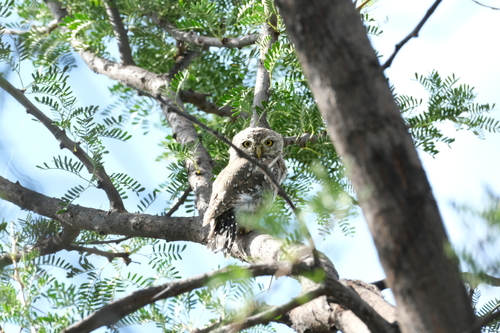
Pearl-spotted Owlet
Glaucidium perlatum
The pearl-spotted owlet is one of the smallest owls in Africa with a length of 17 to 21 cm. The females are slightly larger and heavier (100g) than the males (65g). Both males and females have similar plumage colouration. The facial disc is off-white and the eyes are yellow. At the back of the head there are two striking false black 'eyes' with a white outline. The upper parts are cinnamon-brown with white spots. The tail and flight feathers are brown, with large white spots forming bars in flight. The bill and cere are pale greenish yellow, the legs are feathered white and feet are yellow. Voice: Pearl-spotted owlets call by day and night, especially before breeding, but are quiet when nesting. They have a distinct call: a loud series of shrill, short whistles that accelerate in tempo and rise in volume to a crescendo of long, loud whistles that descend in pitch and volume, peu peu peu-peu-peu peeuu peeeuu. A breeding pair may call in duet, whereby the female is higher pitched.
ID text from Wikipedia, CC BY-SA 4.0
Learn this pair in the BeakBrain App
Photo and call practice. Coming soon to iPhone and Android.
Play today's Daily BirdPhotos and recordings are credited to their authors under the licence shown. Full profiles: Jungle Owlet and Pearl-spotted Owlet.