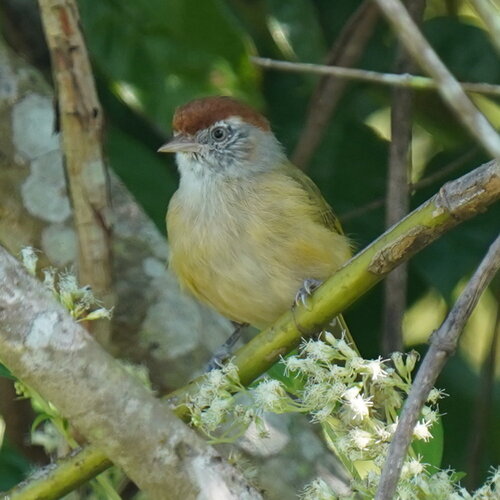
Grey-eyed Greenlet
Hylophilus amaurocephalus
The grey-eyed greenlet is 12.5 to 13 cm (4.9 to 5.1 in) long. The sexes have the same plumage. Adults have a chestnut-brown forehead and crown and a pale grayish supercilium, and is mottled gray-white around the eye and on the ear coverts. Their nape and upper back are dull gray-brown and their lower back, shoulders, and rump are green-tinged gray-brown. Their wings are gray-brown with thin greenish edges on the outer webs of the primaries and secondaries. Their tail is gray-green with brighter edges on the feathers' outer webs. Voice: The grey-eyed greenlet's song is a "high, rather harsh see-see or te Teé-te Teé-te Teé and many other variations".
ID text from Wikipedia, CC BY-SA 4.0
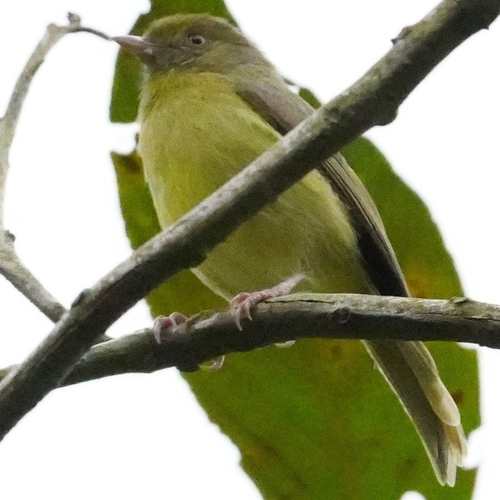
Olivaceous Greenlet
Hylophilus olivaceus
The olivaceeous greenlet is 12 cm (4.7 in) long and weighs 11 to 13 g (0.39 to 0.46 oz). The sexes have the same plumage. Adults have a yellowish olive forehead. The rest of the top of their head and their upperparts, wings, and tail are dull olive-green. Their underparts are yellowish olive that is slightly lighter on the chin and a slightly brighter yellow on the belly. They have a whitish iris, a dull pink or brownish pink bill, and brownish pink legs and feet. Voice: The olivaceous greenlet's song has been described as a "distinctive and loud...series of up to 10-12 musical suwee or peer notes". Another description is "a single note repeated in a series, for example: wee wee wee wee wee wee wee".
ID text from Wikipedia, CC BY-SA 4.0

Learn this pair in the BeakBrain App
Photo and call practice. Coming soon to iPhone and Android.
Play today's Daily BirdPhotos and recordings are credited to their authors under the licence shown. Full profiles: Grey-eyed Greenlet and Olivaceous Greenlet.