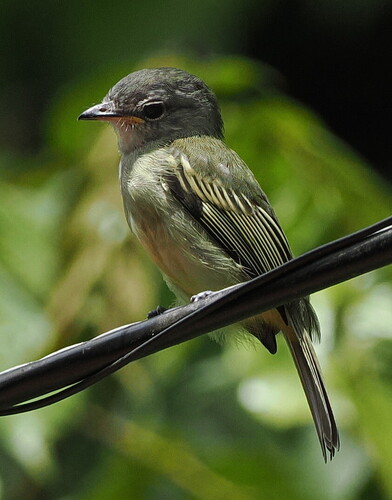
Grey-crowned Flatbill
Tolmomyias poliocephalus
The gray-crowned flatbill is 12 to 12.5 cm (4.7 to 4.9 in) long and weighs about 11 g (0.39 oz). The sexes have the same plumage. Adults of the nominate subspecies have a mostly gray head with a whitish stripe above the lores, a faint whitish eye-ring, and greenish gray ear coverts. Their back, rump, uppertail coverts are olive. Their wings are blackish with yellow edges on the coverts and remiges that appear as two wing bars and sometimes a pale speculum. Their throat is greenish, their breast and flanks olive, and their belly and vent pale yellow. Subspecies T. p. Voice: The grey-crowned flatbill's vocalizations vary among the subspecies. The nominate's song is described as "a repeated, inflected, somewhat wheezy fiwee?" which may be given in a short series or with pauses of one or two seconds between notes. A similar description is "a rising series of clear rising or rising-falling whistles, last notes quavering tuee? tuee? TUEE? tuEEuEE? tuEEuEE?. Subspecies T.
ID text from Wikipedia, CC BY-SA 4.0


Yellow-olive Flatbill
Tolmomyias sulphurescens
The yellow-olive flatbill is 12.5 to 14 cm (4.9 to 5.5 in) long and weighs 14.5 to 15.2 g (0.51 to 0.54 oz). The sexes have the same plumage. Adults of the nominate subspecies T. s. sulphurescens have a dark olive crown and nape, a thin white band above the lores, a thin white eye-ring, and pale olive ear coverts with a dusky patch at their rear. Their upperparts are olive-green. Their wings are dusky or blackish with yellowish-olive edges on the wing coverts that form two wing bars. Their remiges have yellowish edges. Their tail is brownish to dusky with buffy edges on the feathers. Voice: The yellow-olive flatbill's song varies widely among the subspecies. That of T. s. cinereiceps is a "series of 4 thin insectlike buzzes, zeee-Zeee-Zeee-ZEEEE!" and its call a "shrill, sibilant tssssp". In western Ecuador T. s. aequatorialis sings "a thin and well-enunciated series of quick notes, 'psee-pset-pset-pset' ". In northern Venezuela T. s. exortivus gives a "buzzy bzz...bzzz...
ID text from Wikipedia, CC BY-SA 4.0

Where you might meet both
Learn this pair in the BeakBrain App
Photo and call practice. Coming soon to iPhone and Android.
Play today's Daily BirdPhotos and recordings are credited to their authors under the licence shown. Full profiles: Grey-crowned Flatbill and Yellow-olive Flatbill.