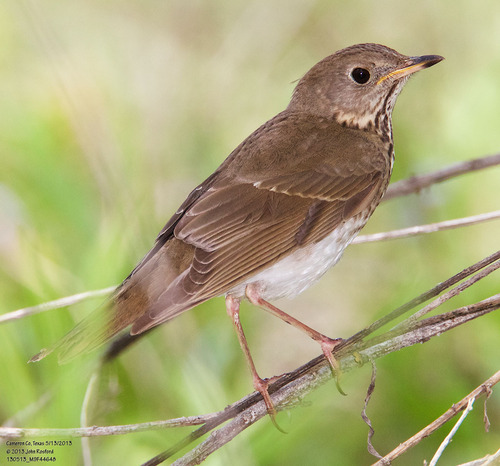
Grey-cheeked Thrush
Catharus minimus
The gray-cheeked thrush is slightly larger than other Catharus thrushes, about 16 to 17 cm (6.7 in) in height and weighing between 26 and 30g. Wingspan ranges from 12.6-13.4 in (32-34 cm). The bird can be identified by its grayish face, partial pale eyering, drab gray-brown upperside and extensively dusky flanks. The area between the eye and the beak is grayish as well, but the area running from the beak to above the eye is grayish white. The gray-cheeked thrush is nearly identical to the Bicknell's Thrush. Voice: The vocalizations of the gray-cheeked thrush are the most reliable way to identify it, compared to the Bicknell's Thrush. It has a complex song of burry flute-like notes, usually inflecting downward at the end. It resembles a descending spiral like the veery (Catharus fuscescens), but higher, thinner, and nasal with stuttering pauses: "ch-ch zreeew zi-zi-zreeee zizreeew".
ID text from Wikipedia, CC BY-SA 4.0
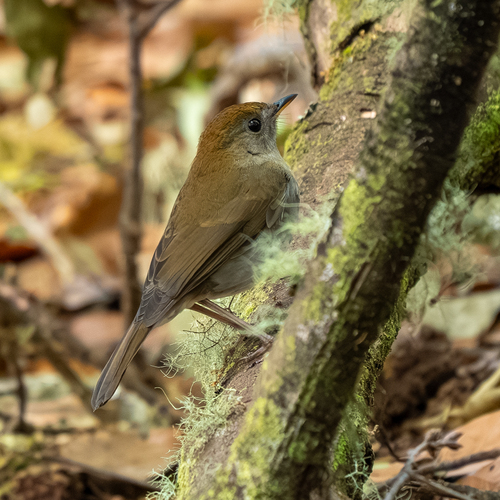
Ruddy-capped Nightingale-Thrush
Catharus frantzii
The ruddy-capped nightingale-thrush is about 15 to 18 cm (5.9 to 7.1 in) long and weighs about 30 g (1.1 oz). The sexes have the same plumage. Adults of the nominate subspecies C. f. frantzii have a rich rufous-brown to russet crown and a grayish face that sometimes has an olive tinge. Their back and rump are brownish olive with a russet wash and their uppertail coverts are deep rufous-brown. Their wings are mostly the same color as the back and rump but with silvery white undersides on the flight feathers. Their tail is deep rufous-brown. Their chin and throat are whitish with dark flecks. Voice: The ruddy-capped nightingale-thrush's song is "an ethereal, melancholic, liquid, and throaty, persistently uttered, and far-carrying series of short, deliberate and diverse phrases, with fluty trills, clear whistles and warbles". It is usually sung in the morning or evening and also in misty weather.
ID text from Wikipedia, CC BY-SA 4.0
Where you might meet both
Learn this pair in the BeakBrain App
Photo and call practice. Coming soon to iPhone and Android.
Play today's Daily BirdPhotos and recordings are credited to their authors under the licence shown. Full profiles: Grey-cheeked Thrush and Ruddy-capped Nightingale-Thrush.