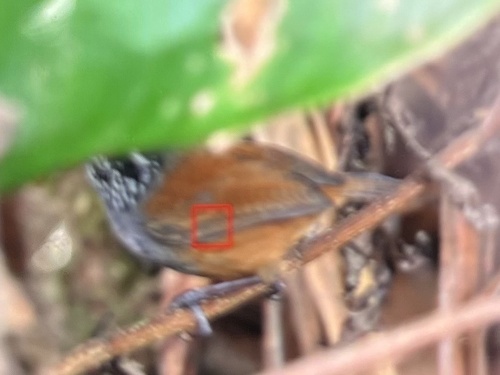
Grey-breasted Wood Wren
Henicorhina leucophrys
The nominate subspecies of grey-breasted wood wren is 10 to 11.5 cm (3.9 to 4.5 in) long and weighs 13.5 to 17.7 g (0.48 to 0.62 oz). Its crown feathers are dull black with dark brown tips. Its nape and shoulders are a dark olive brown and its lower back, rump, and tail chestnut brown. The tail has blackish bars. It has a long gray-white supercilium, a wide black stripe behind the eye, and black cheeks streaked with pale gray. Its chin and throat are pale gray, the chest and belly a darker gray, and the sides of the belly and the lower flanks a dark buff. Voice: The songs and calls of the grey-breasted wood wren vary considerably across its range. In general the songs are "a series of very loud, ringing, energetic musical phrases, frequently repeated". It sings "virtually year-round and throughout the day, in all types of weather" and is "far more commonly heard than seen."
ID text from Wikipedia, CC BY-SA 4.0

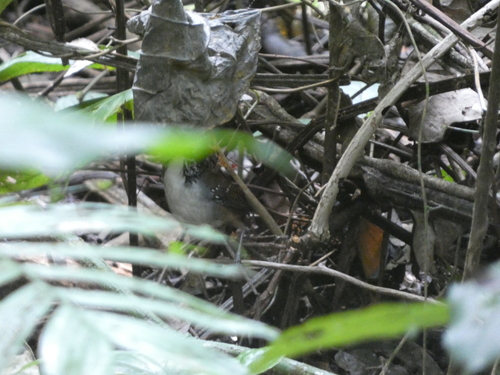
White-breasted Wood Wren
Henicorhina leucosticta
The adult white-breasted wood wren is 10 centimetres (3.9 in) long and weighs 16 grams (0.56 oz). It has chestnut brown upperparts with a darker crown, pale supercilia, and black-and-white streaked sides of the head and neck. The underparts are white becoming buff on the lower belly. The wings and very short tail are barred with black. Young birds have duller upperparts and grey underparts. Voice: The call of this species is a sharp cheek or explosive tuck, and the song is cheer oweet oweet cheery weather; ornithologist and bioacoustics expert Luis Baptista of the California Academy of Sciences compared it to the opening bars of Beethoven's Fifth Symphony. As with some other wrens, pairs often sing in duets.
ID text from Wikipedia, CC BY-SA 4.0

Where you might meet both
Learn this pair in the BeakBrain App
Photo and call practice. Coming soon to iPhone and Android.
Play today's Daily BirdPhotos and recordings are credited to their authors under the licence shown. Full profiles: Grey-breasted Wood Wren and White-breasted Wood Wren.