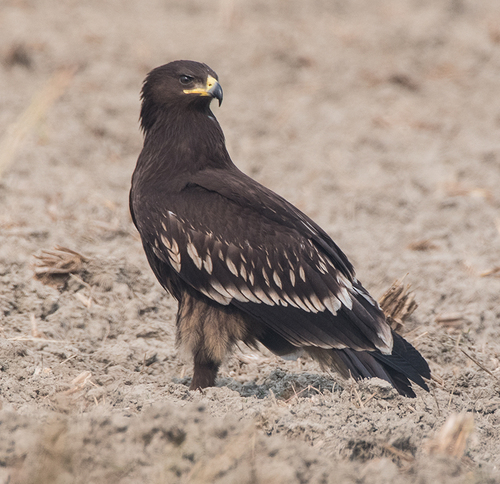
Greater Spotted Eagle
Clanga clanga
The greater spotted eagle is rather large and compact. Normally, it is black-brown with a contrasting yellow beak. This species has a short neck with a large and often shaggy-naped head, a strong beak, and a short gape-line with round nostrils. The wings are broad and long, reaching the tail tip. The tail is relatively short and rounded. The overall effect of the broad wings and short tail can give them an almost vulture-like silhouette. The feet are large, and the feathers covering the legs are less compactly arranged than on lesser spotted eagles. Voice: The greater spotted eagle is quite noisy when breeding and is often very vocal in winter, especially when in small loose flocks. The most common call, often heard during intraspecies conflicts, is a soft, one-syllable, penetrating, high-pitched, urgent whistle, variously transcribed as kyack, kluh, tyuck, or dyip.
ID text from Wikipedia, CC BY-SA 4.0

Indian Spotted Eagle
Clanga hastata
The Indian spotted eagle is about 60 cm in length and has a wingspan of 150 cm. It is broad-headed, with the widest mouth of all spotted eagles. This species is a lighter overall compared to its relatives, with a darker iris that makes the eyes appear darker than the plumage (rather than the other way around as in the two northern spotted eagle species). Adults can be told apart from the greater spotted eagle by its lighter colour, darker eyes, and habitat preference.
ID text from Wikipedia, CC BY-SA 4.0
Where you might meet both
Learn this pair in the BeakBrain App
Photo and call practice. Coming soon to iPhone and Android.
Play today's Daily BirdPhotos and recordings are credited to their authors under the licence shown. Full profiles: Greater Spotted Eagle and Indian Spotted Eagle.