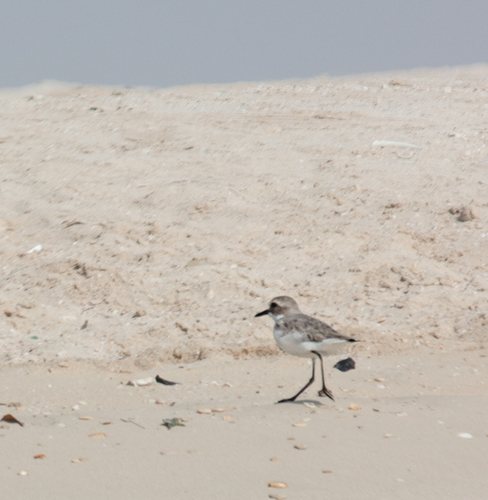
Greater Sand Plover
Anarhynchus leschenaultii
This chunky plover is 19–22 cm long, slightly larger than a common ringed plover, and is conspicuously long-legged and thick-billed. Breeding males have sandy buff backs and white underparts. The breast, forehead and nape are variably orange in summer, and there is a black eye mask in summer. The female is duller and greyer, and winter and juvenile birds are browner, apart from a hint of rufous on the head. The legs are greenish-yellow and the bill black. In all plumages, it is very similar to its close relatives Siberian sand plover A. mongolus and Tibetan sand plover A. atrifrons.
ID text from Wikipedia, CC BY-SA 4.0

Oriental Plover
Anarhynchus veredus
Adult male in breeding plumage: white face, throat and fore-crown; grey-brown hind-crown, hind-neck and back; belly white, demarcated with narrow black band and then broad chestnut breast band merging into white throat. Female, juvenile and non-breeding male: generally grey-brown upperparts and white belly; pale face with white streak above eye. Measurements: length 21–25 cm; wingspan 46–53 cm; weight 95 g. Among the red-breasted Charadrius plovers, this bird is relatively large, long-legged and long-winged.
ID text from Wikipedia, CC BY-SA 4.0
Where you might meet both
Learn this pair in the BeakBrain App
Photo and call practice. Coming soon to iPhone and Android.
Play today's Daily BirdPhotos and recordings are credited to their authors under the licence shown. Full profiles: Greater Sand Plover and Oriental Plover.