
Greater Kestrel
Falco rupicoloides
The plumage of the adult is mainly pale rufous, both above and below. The back, upperwing and flanks are barred with black. The breast has dark streaks and the head is streaked but has no malar stripe unlike the common and lesser kestrels. The rump and tail are grey with black bars; the tail has a white tip. In flight, the whitish underwing contrasts with the darker body. The iris of the eye is whitish, distinguishing the bird from any similar species. The bill is mainly blue-grey and the feet and cere are yellow.
ID text from Wikipedia, CC BY-SA 4.0
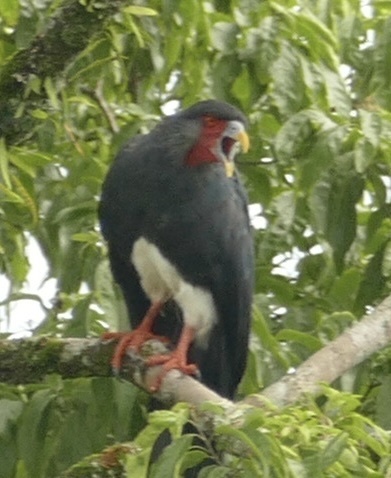
Red-throated Caracara
Ibycter americanus
Males average 20.1 in (51 cm) long, while females average 22.1 in (56 cm); they are distinguished from the black caracara by larger size and plumage that is mainly black, with the belly, tail feathers, and undertail feathers being white. Both their faces and throats are bare, with a few black feathers scattered on the throat; the exposed skin is red. Both male and female red-throated caracaras are similar in appearance. Males have a wing length of 35.55 cm, a tail length of 24.96 cm, a bill length of 2.5 cm, and a tarsal length of 5.41 cm. Females have a wing length of 35.
ID text from Wikipedia, CC BY-SA 4.0

Learn this pair in the BeakBrain App
Photo and call practice. Coming soon to iPhone and Android.
Play today's Daily BirdPhotos and recordings are credited to their authors under the licence shown. Full profiles: Greater Kestrel and Red-throated Caracara.