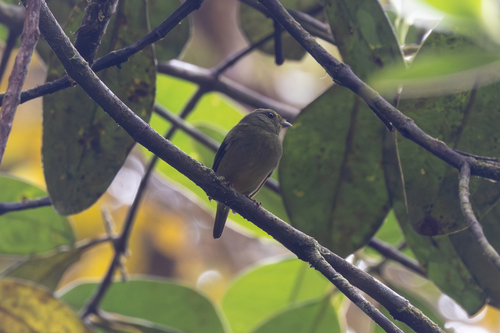
Golden-winged Manakin
Masius chrysopterus
The golden-winged manakin is about 11 cm (4.3 in) long and weighs 9.0 to 13.5 g (0.32 to 0.48 oz). The species is sexually dimorphic. Adult males have a bright golden-yellow forecrown of plush feathers that curve forward over the bill and short black plumes on either side of it that project up as "horns". Their plumage otherwise is mostly black with a patch of orange-red on the hindcrown, a patch of golden-yellow on the throat, and entirely yellow primaries, secondaries, and outermost tail feathers. Adult females are mostly olive-green with a yellow-olive throat, belly, and wing linings. Voice: Male golden-winged manakins make a quiet frog-like "nurrt" call when near their display site. During the "log approach" display they make "a long, whistling seeee-tseet-tseet call ending in a rapid nurrt" as it lands. Both sexes make a thin, high-pitched "tseet" call while foraging.
ID text from Wikipedia, CC BY-SA 4.0


Pin-tailed Manakin
Ilicura militaris
Males measure 12.5 cm (4.9 in), while the females measure 11 cm (4.3 in) from tail to beak at full maturity. There is clear sexual dimorphism between mature adults of this species, but can be nearly impossible to identify the sex for certain if they do not have the adult male colorations, as both juvenile males and females resemble each other. All pin-tailed manakins share some common traits: a forking tail at the very end of their rectrices, a slightly elongated forehead, brownish black legs, and bright yellow-orange irises. Voice: Vocalizations from this bird are often very quiet, but high-pitched. Their songs sound like "see-see-see" in descending tones, with an average anywhere from 3-8 "see" sounds. Many local birdwatchers are fond of this bird, despite it not being particularly rare, because it is difficult to track in the forest through its songs.
ID text from Wikipedia, CC BY-SA 4.0
Learn this pair in the BeakBrain App
Photo and call practice. Coming soon to iPhone and Android.
Play today's Daily BirdPhotos and recordings are credited to their authors under the licence shown. Full profiles: Golden-winged Manakin and Pin-tailed Manakin.