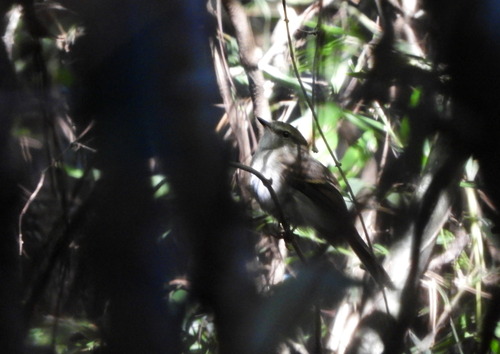
Fuscous Flycatcher
Cnemotriccus fuscatus
The fuscous flycatcher is 13.5 to 15 cm (5.3 to 5.9 in) long and weighs about 12 g (0.42 oz). The sexes have the same plumage. Adult males of the nominate subspecies C. f. fuscatus have a brown crown with a slight rufescent tinge. They have dusky lores, a whitish line above the lores that continues as a supercilium, and a dusky stripe through the eye. Their upperparts are brown with a slight rufescent tinge. Their wings are dusky with wide buffy ends on the coverts that show as two wing bars. Their inner secondaries have thin buff edges and their tertials have whitish edges. Voice: The fuscous flycatcher's vocalizations vary greatly among the subspecies. In Venezuela subspecies C. f. fuscatior sings "a low-pitched, slightly buzzy jaw-jew-jew-jew jew at dawn a shorter rolling pü-breeer-breeer"; its call is "a short, abrupt feétz-beeu". The song and call are similarly described from Ecuador and Peru. C. f. cabanisi gives "a strong, reedy pfEEO! and pfeeu-pfeeu-pfeea".
ID text from Wikipedia, CC BY-SA 4.0
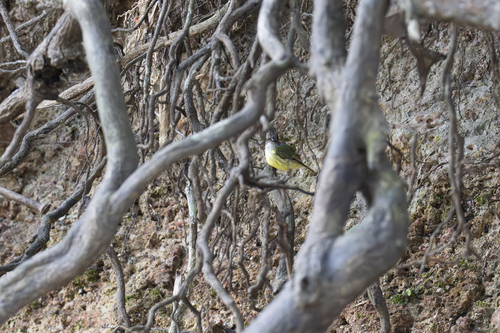
Spotted Tody-Flycatcher
Todirostrum maculatum
The spotted tody-flycatcher is 8.9 to 10.2 cm (3.5 to 4.0 in) long and weighs 6.4 to 8.3 g (0.23 to 0.29 oz). The sexes have the same plumage. Adults of the nominate subspecies T. m. maculatum have a mostly gray head with a small white spot above the lores and some black and white streaks on the crown. Their back, rump, and uppertail coverts are olive. Their wings are brownish black with yellow edges on the flight feathers and yellowish edges and tips on the coverts; the last sometimes show as pale wing bars.
ID text from Wikipedia, CC BY-SA 4.0

Where you might meet both
Learn this pair in the BeakBrain App
Photo and call practice. Coming soon to iPhone and Android.
Play today's Daily BirdPhotos and recordings are credited to their authors under the licence shown. Full profiles: Fuscous Flycatcher and Spotted Tody-Flycatcher.