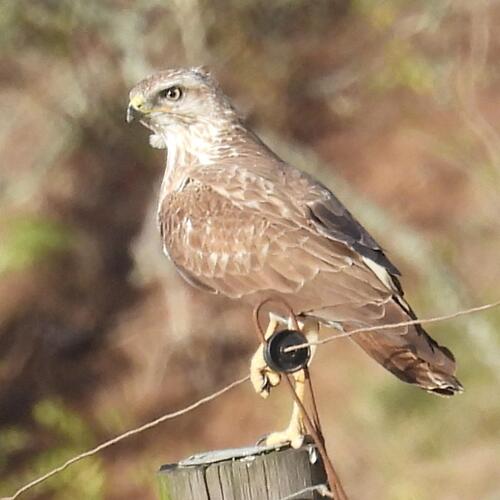
Forest Buzzard
Buteo trizonatus
The forest buzzard is very similar to the abundant summer migrant steppe buzzard Buteo buteo vulpinus, the head, the back and upperwings are brown, marked out with rufous edges to the feathers the amount of which varies between individuals. The chin is whitish and unmarked, the breast and belly are whitish but marked with a variable amount of brown spots, and the undertail coverts are plain whitish.
ID text from Wikipedia, CC BY-SA 4.0
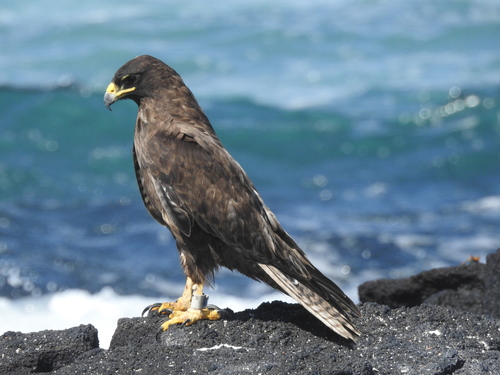
Galapagos Hawk
Buteo galapagoensis
The Galapágos hawk is similar in size to the red-tailed hawk (Buteo jamaicensis) and the Swainson's hawk (Buteo swainsoni) of North America, but the size is variable across the islands as is recorded for many animals native to the Galapágos. They appear to be somewhat more heavily built than those well-known mainland species, and going on average weights, this species is the second heaviest Buteo in the Americas, behind only the ferruginous hawk. The Galapágos hawk can range from 45 to 58 cm (18 to 23 in) in length from beak to tail with a wingspan of 116 to 140 cm (46 to 55 in). Voice: The call of the Galapágos hawk is a series of short screams similar to the call of the red-shouldered hawk that has been described as a "keer, keeu," or an inflected "kwee". Especially noisy during mating season, their call softens to a "kilp, kilp, kilp".
ID text from Wikipedia, CC BY-SA 4.0
Learn this pair in the BeakBrain App
Photo and call practice. Coming soon to iPhone and Android.
Play today's Daily BirdPhotos and recordings are credited to their authors under the licence shown. Full profiles: Forest Buzzard and Galapagos Hawk.