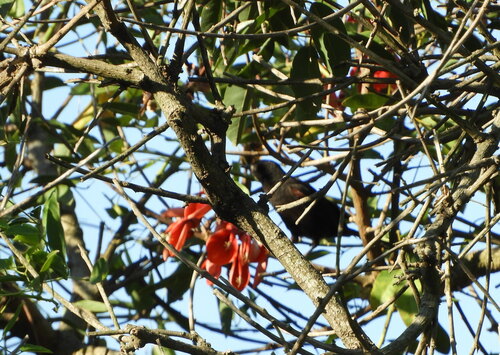
Epaulet Oriole
Icterus cayanensis
The epaulet oriole is about 22 cm (8.7 in) long. Males weigh an average of about 45 g (1.6 oz) and females an average of about 42 g (1.5 oz). The sexes have the same plumage. Adults of the nominate subspecies are almost entirely black. They have yellow lesser and median wing coverts that show as the eponymous epaulet on the closed wing. Subspecies I. c. chrysocephalus is also mostly black but has a golden-yellow crown, nape, rump, epaulets, and thighs. Juveniles of both subspecies are blackish brown rather than pure black and their yellow parts are duller than adults'. Voice: The two subspecies of the epaulet oriole have different but similar songs. That of the nominate is "not very musical and has been described as a varied series of ascending and descending notes, also mixing clicks and buzzes". That of I. c. chrysocephalus is "a slow series of ascending and descending notes, usually grouped in phrases of two to three notes".
ID text from Wikipedia, CC BY-SA 4.0

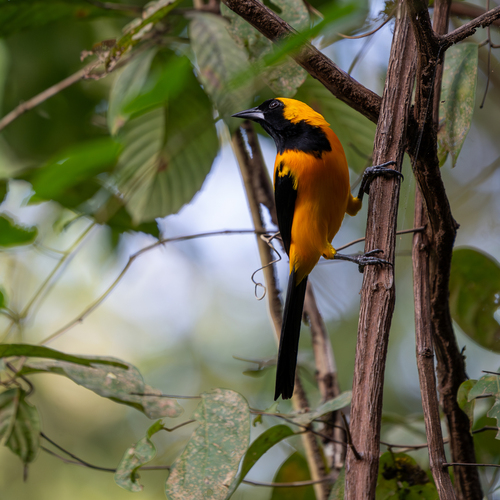
Yellow-backed Oriole
Icterus chrysater
Yellow-backed orioles are a yellow-bodied, sexually monomorphic species. They average 21.5 cm (8.5 in) in length from beak to tail; making it a relatively medium-sized oriole species. Exposed skin and claws are bluish-black; in adults, the bill is black, with the base of the mandible becoming bluish-grey. Adult males display strongly contrasting yellow and black plumage. The wings, tail, shoulders, throat, and face are all black; by contrast, the back and underparts are an extremely bright yellow. Adult females closely resemble males, but yellow parts appear slightly greenish.
ID text from Wikipedia, CC BY-SA 4.0

Where you might meet both
Learn this pair in the BeakBrain App
Photo and call practice. Coming soon to iPhone and Android.
Play today's Daily BirdPhotos and recordings are credited to their authors under the licence shown. Full profiles: Epaulet Oriole and Yellow-backed Oriole.