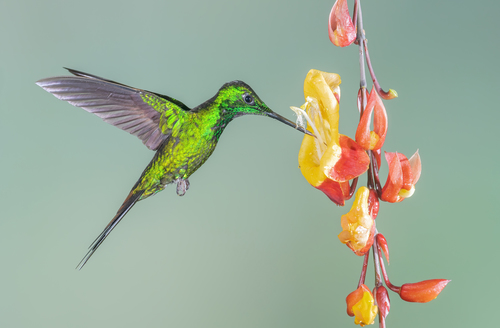
Empress Brilliant
Heliodoxa imperatrix
Male empress brilliants are 15 to 17 cm (5.9 to 6.7 in) long and weigh about 9.3 g (0.33 oz). Females are 12 to 13.5 cm (4.7 to 5.3 in) long and weigh about 8.3 g (0.29 oz). The adult male's forehead, face, and breast are mostly glittering dark green, with a square glittering pale violet patch in the center of the throat. Its crown and nape are dark green and the rest of the upperparts dark bronzy green. Its belly is glittering golden green. The central tail feathers are dark bronze and the rest longer and black with a bronze gloss. The adult female's upperparts are bronzy green. Voice: One empress brilliant vocalization is a "repeated single 'tsit' note". It is also given singly while hovering and feeding.
ID text from Wikipedia, CC BY-SA 4.0

Fawn-breasted Brilliant
Heliodoxa rubinoides
The fawn-breasted brilliant is a medium-sized hummingbird, measuring 11 to 13 cm (4.3 to 5.1 in) in length and weighing approximately 7.2 to 10.2 g (0.25 to 0.36 oz). The bill is stout, fairly long (22–27 mm (0.87–1.06 in)), slightly decurved, and black. Adult males have shining bronzy-green upperparts, with coppery tones on the wing coverts and a slightly forked, coppery-green tail. The underparts are warm buffy-cinnamon, with irregular green spotting on the flanks and throat sides. A distinctive feature is the small, isolated pinkish to lilac gorget patch on the lower throat. Voice: The fawn-breasted brilliant produces two main vocalizations: a series of sharp, metallic "tchik" notes, often given in rapid succession as an alarm or territorial warning, and a common "swi-swi-swi-swu" call. Non-vocal communication includes the audible buzzing of wings during flight and displays, as well as tail fanning during aggressive or courtship interactions.
ID text from Wikipedia, CC BY-SA 4.0

Where you might meet both
Learn this pair in the BeakBrain App
Photo and call practice. Coming soon to iPhone and Android.
Play today's Daily BirdPhotos and recordings are credited to their authors under the licence shown. Full profiles: Empress Brilliant and Fawn-breasted Brilliant.